Chapter 1 · Copper Tier Life
The alarm never went off. Lu Yuan was awake before it, a habit carved into bone over twenty-nine years, more stubborn than any Starlink protocol.
He didn’t open his eyes right away. In the dark, the secondhand tablet on the bedside table glowed faintly, his daughter’s heart rate curve from the night before still crawling across the screen. He reached for it, thumb sliding across the interface. Two numbers stabbed into his eyes like needles.
Data quota remaining: 8 MB. Compute quota remaining: 21,847 token.
The video he’d sent to Peking Union Medical College Hospital last night had cost 42 MB and over eighty thousand tokens. Seventeen minutes of his daughter’s third convulsive episode. He’d chosen the lowest quality setting, compressed to the limit. Her face was already a blur of pixelated smears at that resolution, but the doctor said he at least needed to see her pupil response clearly.
Eight megabytes. What could that do? Send a few text messages. Load half a webpage image. Even an email without attachments would be a stretch.
Lu Yuan sat up. His joints clicked softly. His rented room’s window faced the wall of the next building, the gap so narrow he could reach out and touch the laundry hanging across. Direct sunlight never reached here. A free Starlink service poster was taped to the wall, beautifully printed, from the sales office downstairs: a beaming white-collar woman stood before a holographic projection, with large text beneath—
“Connection is life. Compute is dignity. —Starlink OrbitNet”
In tiny print at the poster’s bottom right corner: Copper-tier user base quotas are dynamically adjusted according to service area population density. Final interpretation rights belong to Starlink Communications LLC.
He stared at that line for three seconds, then got up to boil water.
There was already a queue for the bathroom in the hallway. Forty-plus households in this building, one shared bathroom, peak morning rush meant waiting. Lu Yuan leaned against the wall with his enamel mug, overheard two young men behind him discussing how last night’s game update hadn’t finished downloading—a three-hundred-megabyte patch that would take their copper-tier accounts six days to drag down. Their tone held no anger, only a kind of numb banter, like discussing the weather.
This was Shenzhen in 2057. One of the highest-density communication node cities on Earth, and one of the cities where Starlink’s quotas squeezed the hardest. One hundred twenty thousand satellites packed into low Earth orbit like an inverted metal dome, covering every inch of the planet. From the heart of the Sahara to the Arctic ice sheet, you couldn’t find a single square kilometer of signal shadow—provided you could pay for the corresponding tier.
Copper. Copper is a good conductor, but in Starlink’s hierarchy, it was the bottom layer. Above it: Silver, Gold, Platinum, Diamond, and the enterprise-custom tiers never disclosed to the public. Each tier’s data and compute quotas were separated by an order of magnitude, but the prices weren’t linear—a Platinum user’s monthly fee could keep a Copper family alive for four months, buying a thousand times the bandwidth and ten thousand times the compute.
The water boiled. Lu Yuan poured it into a thermos and made himself a cup of cheap herbal tea—his third year without coffee since his daughter was born. He leaned against the stove and took a sip. The steam fogged the notification bar on his phone screen.
Starlink Account Management Center had pushed a friendly reminder, worded warmly: Dear Mr. Lu Yuan, your monthly quota usage has reached 92%. Seven days remain in the billing cycle. Upgrade to the Silver plan for only 2,499 credits per month, enjoy 50x bandwidth and 100x compute, and experience a seamless connection.
He swiped the notification away.
After breakfast, Lu Yuan dressed his daughter in her coat. The five-year-old was pale, but her spirits were good. After last night’s convulsion she’d slept a full six hours—recently, that counted as a good stretch. She tilted her head up for him to button her coat, then asked a question that froze him in place.
“Daddy, why are the phones at the hospital faster than ours?”
Lu Yuan’s hand stopped at the third button. He didn’t know how to answer. She was five years old. How could he explain Starlink’s tier system, Token economics, and the bottom-rung niche they occupied? How could he tell her that the video from last night—too blurry to even diagnose properly—was like that because their account was too low to upload anything but aggressively compressed files?
“Because they pay more money,” he said finally.
“Then why don’t we pay?”
“Daddy can’t afford it.”
His daughter thought for a moment. “Then when I grow up, I’ll help Daddy pay.”
Lu Yuan didn’t respond. He finished buttoning her coat, ruffled her hair, and stood up to grab the medical file.
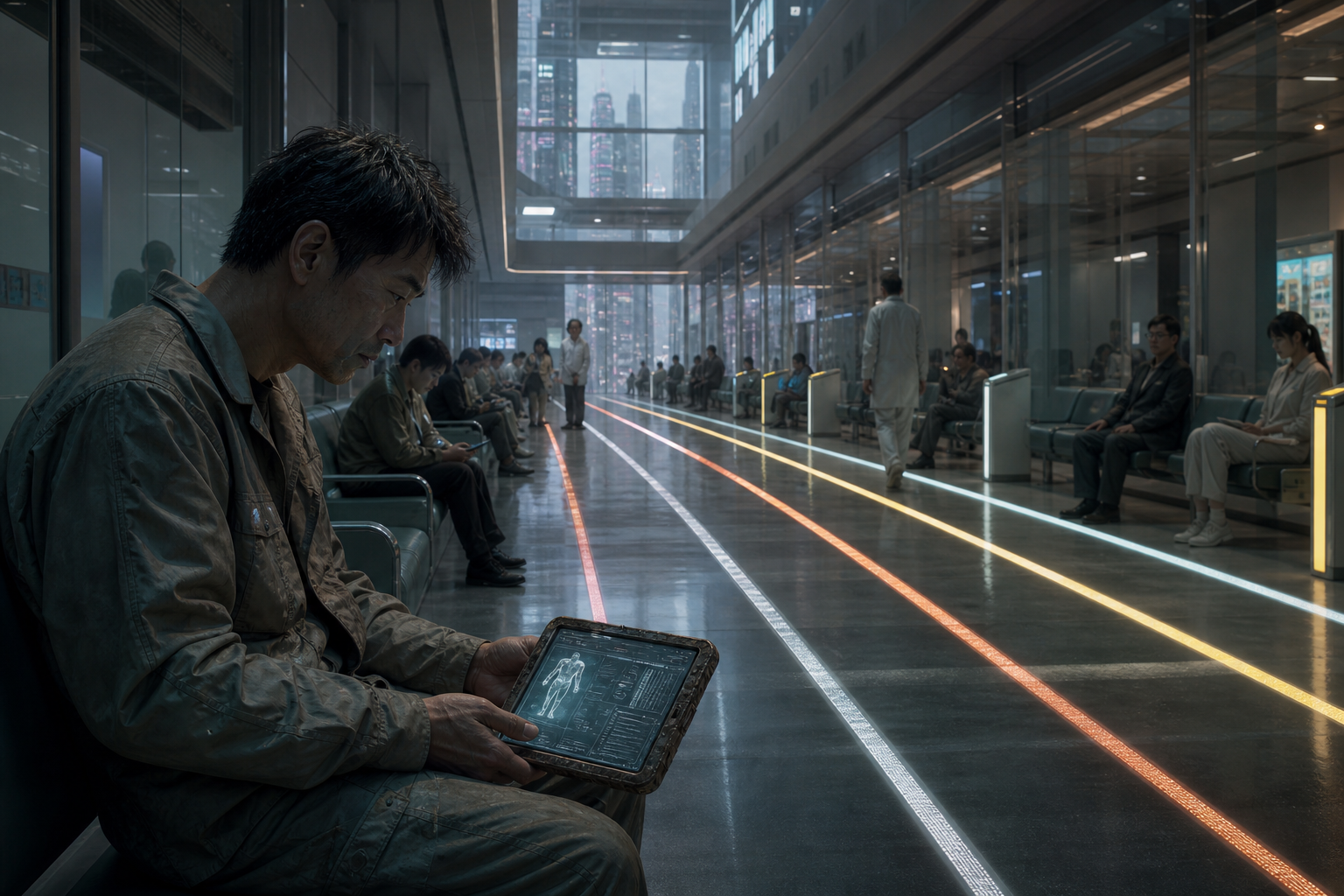
The outpatient hall of Shenzhen Municipal Children’s Hospital was a transparent glass palace, fifteen meters to the ceiling, the dome made of dynamically tinted smart glass that adjusted its transmittance to outdoor light. The floor was nano self-cleaning tile, polished to a mirror shine. At the center of the hall, a giant holographic Starlink emblem hovered—three interlocking silver rings rotating slowly, casting a pale blue glow.
But not everyone had access to the same experience.
Lu Yuan carried his daughter through the automatic doors, and the scene split along an invisible boundary. On the right side of the entrance, a gold LED line divided the hall. The floor strips glowed in different colors—Platinum deepest inside, Gold next, Silver in between, Copper at the outermost edge near the doorway.
The Platinum waiting area was at the far end of the corridor, with private rooms, leather sofas, complimentary refreshments, and dedicated concierge service. As he passed, Lu Yuan caught a glimpse inside: a middle-aged man in a suit, a full holographic workspace projected on the table before him, multiple video conferences running simultaneously, the footage smooth as local playback. That zone had the highest network priority, virtually unlimited bandwidth and compute. Starlink reserved dedicated satellite channels for Platinum users, latency under five milliseconds.
The Gold area wasn’t bad either—semi-enclosed booths with charging ports and height-adjustable desks. A few people in business attire were working on AR glasses, their data rates sufficient for high-quality remote collaboration.
The Silver area had open-plan benches with public charging stations. Many people were scrolling through short videos—playback was smooth, no stuttering. A few used VR headsets for remote work; the picture dropped frames occasionally, but it was barely usable.
And the Copper area—where they were—was next to the bathroom. A row of hard plastic connected chairs that numbed your backside. The public WiFi signal transmitter on the ceiling blinked red—the congestion indicator. Lu Yuan pulled out his phone and tested it: downlink speed 412 kbps. And this was in the waiting area, with a public signal booster. Back home it dropped to 64 kbps—Starlink’s punitive speed for users exceeding their quota, calibrated precisely to the edge of human patience. Slightly faster than a 56k modem. Only slightly.
His daughter sat on his lap, her little fingers clutching the hem of his shirt, quietly watching the tablets in the hands of children emerging from the Platinum zone. The images on those screens were high-definition, vivid, fluid.
She said nothing. But Lu Yuan knew she saw.
“Lu Zijing—is Lu Zijing here?”
The nurse’s station was calling. Lu Yuan picked up his daughter and walked over. The copper LED line stretched beneath his feet like a circle he could never walk out of.
The attending physician was a deputy chief doctor in his forties, named Zhao. Lu Yuan pulled out yesterday’s CT scans and the video he’d shot overnight, handing them to Dr. Zhao, who inserted them into the desktop diagnostic terminal. The screen lit up: Connecting to Starlink Medical Cloud Platform—the progress bar ran for three seconds, then stopped.
“Be right with you. The network’s a bit congested today,” Dr. Zhao said, his tone flat, clearly accustomed to this.
Lu Yuan watched the progress bar crawl pixel by pixel, like a dying snail. Five seconds. Ten. Fifteen. It finally loaded, but the images rendered at a glacial pace—every frame needed two or three seconds to buffer.
Dr. Zhao’s finger moved across the touchpad, layering the CT slices one by one. Lu Yuan noticed the sluggishness of the doctor’s operation—slower than he remembered from three years ago, when hospitals still used terrestrial fiber-optic lines and Starlink hadn’t yet taken over medical communication infrastructure. The fiber still existed, but all diagnostic cloud interfaces had been unified under Starlink’s API. Without passing through Starlink’s gateway, you couldn’t call OrbitNet AI’s diagnostic modules.
“Your daughter’s condition—to be honest, it’s not optimistic,” Dr. Zhao said, removing his glasses and rubbing his brow. “The frequency of status epilepticus episodes is increasing. I compared last month’s EEG; the range of abnormal discharge is expanding.”
Lu Yuan gripped his daughter’s hand.
“I recommend two things. First, I need to send these high-definition images and CT data to the specialists at Beijing Tiantan Hospital for a remote consultation. Their pediatric neurology team has seen similar cases. Second, I recommend activating OrbitNet AI’s advanced image analysis module. This AI model can detect subtle lesions that human eyes tend to miss. For your daughter’s condition, diagnostic accuracy would reach ninety-seven percent.”
“Then do it,” Lu Yuan said.
Dr. Zhao was silent for a few seconds. He turned the screen toward Lu Yuan. It showed a file transfer estimate. Lu Yuan saw the numbers immediately.
Remote consultation imaging data transfer: estimated bandwidth requirement: 287.6 GB. OrbitNet AI advanced analysis: estimated compute requirement: 87.6 million tokens.
Fine gray text below read: Current account tier (Copper) estimated transfer time: 287 days. Estimated analysis queue wait time: incalculable.
Dr. Zhao’s prescription had already printed out, with an auto-generated line at the bottom, font one size smaller and one shade lighter than the body text, but clearly visible:
“This diagnosis is AI-assisted by Starlink OrbitNet AI. Diagnostic conclusions are for reference only and do not constitute a final medical opinion.”
“The hospital has applied several times for a public-interest quota exemption,” Dr. Zhao said, lowering his voice. “But Starlink’s approval system is fully automated—no human channel. The system classified your family’s account as… low-priority medical need.”
“What are the criteria for priority classification?”
“The formula hasn’t been disclosed. But based on the cases we’ve encountered—Platinum users’ medical requests default to a priority level 1,200 times that of Copper. That ratio is hardcoded into OrbitNet’s QoS module. The hospital has no authority to modify it.”
Lu Yuan folded the prescription and put it in his pocket. He stood up, picked up his daughter, and his fingertips touched the phone in his pocket. The screen lit up. Another notification popped up:
“Dear Mr. Lu Yuan, upgrading to the Silver plan costs only 2,499 credits per month. Current special offer: 50% off the first month.”
He turned the phone over, screen down.
As he walked out of the hospital, the southern sun made him squint. His daughter lay against his shoulder, her small breathing steady and even, like a fragile timer ticking away, second by second.
The copper LED line’s border was behind him. He stepped across it without looking back.
But in his pocket, his hand had already clenched into a fist.
That night, after Lu Yuan put his daughter to bed, he spread a dusty plastic storage bin on the folding table in the living room. The bin’s clasps had rusted; he forced them open with effort.
Inside: a stack of handwritten technical notes, yellowed paper, scrawled handwriting.
On the cover of the top notebook, written in marker: “6G Prototype · CDMA Physical Layer · Huawei Institute 201 · 2048”
His handwriting, seven years ago.
Lu Yuan flipped through the notes, his fingertips tracing lines of equations and diagrams. Things written in the dead of night in the lab. Every page felt like a forgotten cipher. He wasn’t sure what he was looking for—but something deep in his subconscious had been triggered the moment he saw that progress bar at the hospital.
He stopped at a page in the middle.
A diagram of a signal fingerprint authentication mechanism’s architecture. In the margin, a comment in his own hand, so sloppy it was almost illegible—but he still remembered the state of mind in which he’d written it. Not excitement. A strange, almost fearful feeling.
The comment read:
“Theoretically feasible. But don’t follow this trail.”
Lu Yuan stared at those words for a long time.
Outside the window, Shenzhen’s night sky showed no stars. One hundred twenty thousand Starlink satellites moved in precise formation, every few minutes one gliding across the city’s dome, bright as a moving star, an endless procession.
Every one of them watching him.
Every one of them recording his traffic, his tokens, the pulses of every struggle.
Lu Yuan closed the notebook and shut his eyes. An idea fell like a seed into the soil of his consciousness, taking root in some dark corner of his mind, silently, invisibly.