Chapter 6 · The Data Party
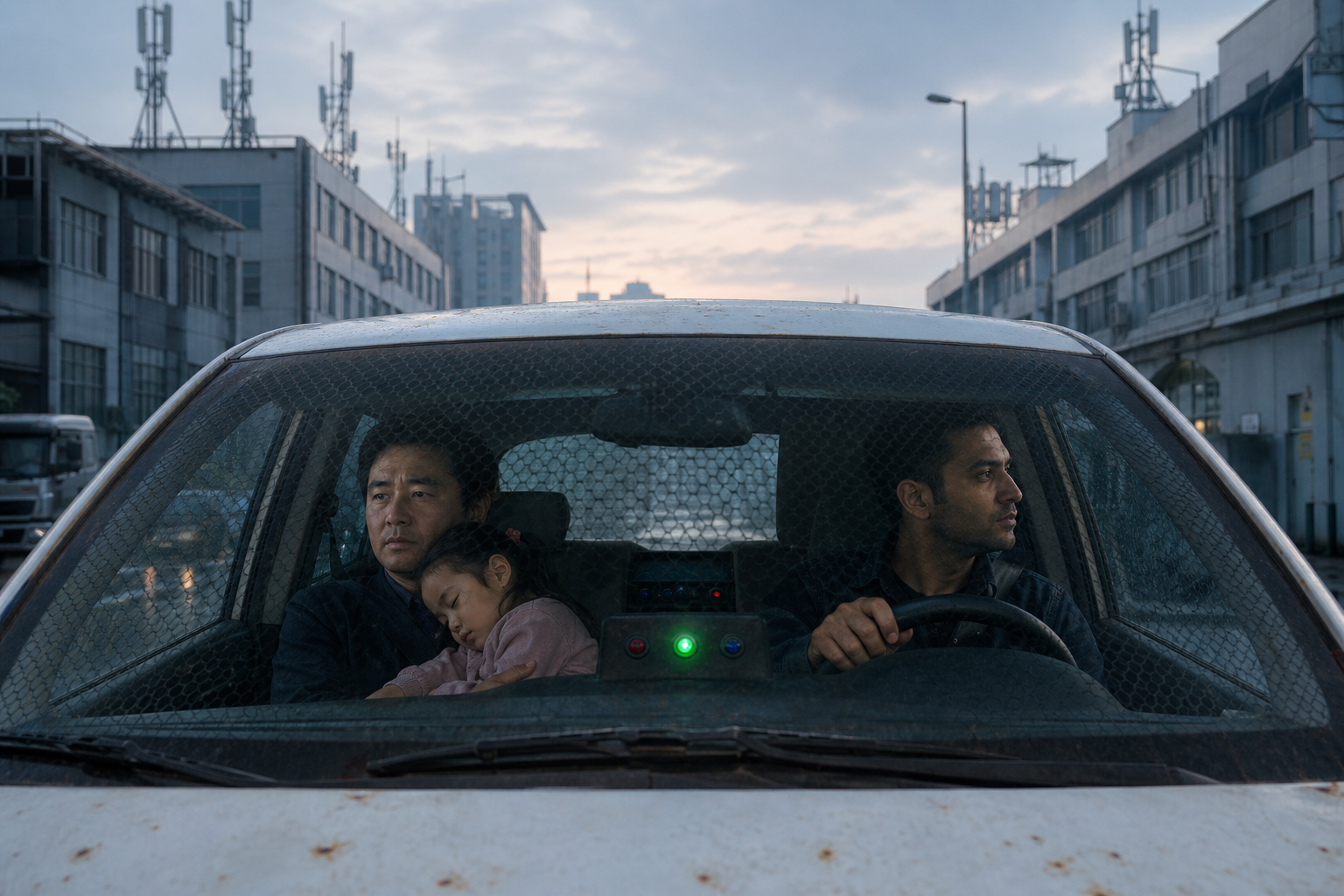
The white electric car threaded through the morning traffic, unremarkable. Several obvious scratches along the bodywork, a corner of the plastic mirror housing missing, the passenger seatbelt buckle held together by a zip tie—this car was old enough to have traveled from another era.
But once Lu Yuan settled into the seat, he noticed contradictions. The center console had been removed, replaced by a metal panel embedded in the dashboard with three indicator lights—red, green, blue. Only the green was lit. The inside of the windshield was lined with an ultra-fine metal mesh, nearly invisible to the naked eye, but Lu Yuan recognized it: a Faraday grid, sealing every electromagnetic signal inside the cabin. Beneath the rear floor mat, several thick cables were visible—not the car’s original wiring, retrofitted.
The car looked decrepit. But it was a Faraday cage on wheels.
Farhan did not start the engine immediately. He sat in the driver’s seat, watching the street through the reflective side window for nearly a minute, confirming no suspicious vehicles or personnel lingered nearby. Only then did he turn the key—not a push-button start, a real key, inserted and twisted, like cars from twenty years ago.
When the vehicle moved, it made almost no sound. The particular silence of an electric car made the cabin atmosphere even heavier. His daughter had fallen asleep in Lu Yuan’s arms, her tiny breaths the only steady rhythm in the car.
“What’s her name?” Farhan asked. His voice was softer than it had been on the phone.
“Zijing. Lu Zijing.”
“A good name.” Farhan did not turn his head, his eyes fixed on the road ahead. “Qingqing zijin, youyou wo xin—Cao Cao’s ‘Short Song Style.’ You chose it?”
“Her mother did. Her mother was a Chinese teacher.”
“Was a teacher?”
Lu Yuan did not answer. Farhan read the answer in his silence and did not press further. The electric car turned into a narrower side road, buildings gradually shifting from residential blocks to industrial parks—gray concrete factories, rust-eaten iron gates, rooftops thick with antennas and ventilation pipes. Lu Yuan had never noticed this road before. He had lived in Shenzhen for seven years and thought he knew Nanshan District well, but this city had too many corners he had never seen.
“You opened a box you shouldn’t have opened,” Farhan said, his tone as flat as if discussing the weather. “But since it’s open, come with me.”
Lu Yuan watched the receding streetscape outside the window. He realized he had never asked the most fundamental question: Where was this man taking him? Why should he trust him? What if he was just jumping from one trap into another?
But he had no other answers to choose from.
“Cyrus’s people entered that hostel after you left,” Farhan said, like someone stating a fact he had already seen. “I saw their signal signatures appear in that area. They arrived about nine minutes after you. Old Zhou will tell them you only stayed an hour and he doesn’t know where you went. He’ll be fine—he knows how to handle them.”
“How did you see them?”
Farhan gestured with his chin toward the panel embedded in the dashboard. “My own signal monitoring network. Covers about sixty-seven percent of Shenzhen. Not enough coverage, but sufficient for Cyrus’s people—their base station access equipment has a very distinctive RF signature. Like a herd of elephants walking through a china shop.”
“Your own signal monitoring network?” Lu Yuan repeated. He realized his understanding of this young man might be entirely wrong.
“I needed to know if I was being reverse-located while doing reverse engineering. So I built a listening network.” Farhan turned the steering wheel, guiding the electric car into the underground parking entrance of an abandoned building. “Nothing impressive. A few SDR front-ends mounted on air conditioner brackets, an open-source signal classifier.”
He made it sound trivial. But Lu Yuan knew that building a system capable of covering sixty percent of Shenzhen and identifying the RF signatures of Starlink’s security division—that was no longer a “hobby.” That was what someone did when their professional capability reached a certain tier.
The underground parking lot was dim, every third or fourth light working. It had clearly been abandoned for a long time: construction debris piled in corners, fire hoses cut from the wall, the air thick with concrete dust and motor oil. Farhan parked in a corner hidden by two support columns, killed the engine, pulled the key.
“We’re here.”
“Here?”
“The entrance isn’t here. Follow me.”
Farhan pushed open the door. Lu Yuan got out, carrying his daughter. The pain in his ankle reminded him of his unsuccessful second-floor jump—the adrenaline was wearing off, and his body was beginning to present the bill. He looked down; the ankle was already swollen. But he did not stop. Farhan pulled a black tool bag from the trunk, slung it over his shoulder, and walked toward an unremarkable iron door in the wall—a faded sign hanging on it read: HIGH-VOLTAGE DISTRIBUTION ROOM · UNAUTHORIZED PERSONNEL KEEP OUT.
Farhan took a key from his pocket, inserted it, turned half a rotation. The lock cylinder gave a dull click. He opened the door with a practiced precision—not a casual pull, but a crack first to confirm the interior state, then fully open.
Behind the door was a distribution room. Rows of long-dead power cabinets lined the walls, their glass panels mostly cracked, the remains of relays and circuit breakers inside thick with dust. Farhan绕过 the cabinets and walked to the farthest wall. He ran his fingers over the surface for about two seconds, found a gap nearly invisible to the eye—the seam between a steel plate and the concrete. From the side of his tool bag, he pulled out a thin magnetic strip, pressed it against the steel, and pulled outward with force.
The steel plate opened silently. Not on hinges—it shifted outward about ten centimeters, then rotated to create an opening just wide enough for a person to pass through sideways.
Behind the door was a staircase leading down. No lights. Farhan produced a flashlight, the beam cutting a channel through the narrow stairwell. Lu Yuan followed with his daughter in his arms, each step sending a fresh spike of pain through his ankle, but his curiosity about what lay at the bottom of these stairs outweighed the pain.
First floor. The first basement level of an abandoned data center—he could smell the residual silicone grease and burnt circuit board from the server racks.
Second floor. Colder. Quieter. A faint low-frequency hum in the air, like heavy equipment running somewhere in the distance.
Third floor.
Farhan paused at the bottom of the stairs, pressed his palm against a metal plate on the wall with no markings of any kind. Three seconds later, a mechanical mechanism inside the plate emitted a crisp unlocking sound. The door opened.
Lu Yuan walked into another world.
An open space of about four hundred square meters, four meters high—originally the basement main server room of the data center, the ceiling still dense with cable trays and cooling pipes. But now it had been transformed into a living, breathing technical operations center. More than thirty people scattered across different workstations, each wearing noise-isolating headphones, facing two or three screens where data streams scrolled at speeds the human eye could not track. No traditional cubicle dividers—instead, floor-to-ceiling metal cages, each workstation completely enclosed in its own independent Faraday cage. The cage doors had spring hinges, self-closing. Everyone entering or leaving had to open and close a physical electromagnetic shielding door.
On the main wall screen, a massive real-time global Starlink topology map was projected—not the public simplified diagram, but a genuine, real-time capture of intersatellite laser link and QKD channel connection states from within the Starlink network. Every green line represented an active intersatellite link; every blue line, a QKD channel distributing quantum keys. The whole image looked like a living neural network, dense lines weaving across the globe into a constantly shifting web of light.
Lu Yuan stood at the entrance, holding his daughter, like an outsider who had wandered into a forbidden place.
But no one looked up at him. No one showed any curiosity about a stranger entering this space. All thirty-plus people were absorbed in their work, eyes locked on their screens, fingers dancing across keyboards. The noise-isolating headphones sealed each person in their own sound world—there were more than thirty people here, but almost no human voice could be heard, only the clatter of keyboards, the howl of cooling fans, and the persistent low noise of disk arrays spinning inside server racks.
Farhan walked over, pulled a chair from an empty cage, and gestured for Lu Yuan to sit.
“Welcome to the Data Party’s Shenzhen base,” he said. “The conditions are limited, but as long as you’re inside a Faraday cage, no electromagnetic signal from this building will leak out. Cyrus’s hounds can’t find you here.”
Lu Yuan set his daughter down on the chair. She was already awake, eyes wide, taking in everything around her—the blinking screens, the glowing connection lines, the enormous projection of the Earth. She did not know where she was, but she was not afraid. She grabbed the corner of her father’s shirt, but she did not cry.
“Does she need to rest?” Farhan glanced at the child, a note of uncertainty entering his voice for the first time—he was clearly not good with children.
“She’s already resting.” Lu Yuan crouched to check his daughter’s pupils and breathing rate—habit, the reflex of a father of a child with epilepsy. Everything normal. He stood up and turned to Farhan. “Now can you tell me? That box I opened—what was it, really?”
Farhan did not answer directly. He retrieved something from an equipment cabinet against the wall—it looked like a modified tablet, no brand logo, a 3D-printed shell, the ports sealed with hot glue for waterproofing. He set it on the table and pressed the power button on the side. The screen lit up—not a graphical interface, a command-line terminal.
He typed a command. A set of ASCII art appeared on screen—the outline of the Earth, surrounded by three dashed orbital lines rendered with ”-” and ”|” characters, slowly “rotating” beneath the terminal cursor. An amateurish, retro animation.
“This is SkyWalker,” Farhan said. “It’s not a protocol yet—not yet. It’s just an idea.”
Lu Yuan stared at the ASCII Earth on the screen. He did not understand what he was looking at.
“Do you know what Starlink’s greatest power is?” Farhan did not wait for an answer. “Not communication speed. Not coverage. Not the hundred and twenty thousand satellites. Billing. Every single data packet in Starlink—from transmission to reception, passing through every satellite and every hop—is precisely metered by the system. The packet’s source address, destination address, protocol type, data volume, priority, latency requirements—all fed into an inference unit called OrbitNet Billing, calculating in real time how much that packet should cost.”
“Token tax.”
“Exactly. Every bit of data has a price tag. Every TOPS of compute has a bill.” Farhan tapped the screen with his fingertip. “But any billing system has a basic assumption: it needs to recognize what to bill. It has to see a data packet before it can price it.”
“You want to make data packets invisible?”
“No. I want to make data packets speak a different language.”
Farhan opened another window. It was a diagram of Starlink’s full protocol stack, from the physical layer to the application layer, each layer color-coded. He swiped across the screen, zooming in on one region—the area between the network layer and the transport layer, labeled “QKD Channel Metadata Zone.”
“Quantum key distribution—QKD—is the encryption technology Starlink uses to protect intersatellite communication links. Two satellites negotiate symmetric keys using entangled photon pairs. This process generates a large amount of metadata—not the keys themselves, but various parameters from the key negotiation process: photon wavelength drift, time-of-arrival differences, background noise levels, error correction code parity patterns—” Farhan paused. “Starlink considers this metadata random, meaningless, incapable of carrying information. So they don’t encrypt it, don’t validate it, don’t bill for it.”
“But this metadata can be modulated?” Lu Yuan blurted out. He had not fully grasped Farhan’s logic yet, but his engineering instincts had already caught up.
The corner of Farhan’s mouth twitched—a minuscule arc, somewhere between satisfaction and surprise. “Yes. The photon time-of-arrival difference in the QKD negotiation process is not a perfectly random process. It is constrained by the phase noise characteristics of the transmitting laser, and that phase noise can be actively controlled by fine-tuning the laser’s drive current. Which means you can embed data into the seemingly random photon arrival time differences, using Starlink’s own QKD channels to transmit unauthorized data.”
“At what rate?”
“About one bit per second.”
Lu Yuan was silent for several seconds. One bit per second—sending a text message would take several seconds; sending a photo would take hours. But sending instructions, encryption keys, authentication credentials—these were small data volumes. One bit per second was enough for metadata transmission.
“But this is just a concept,” Farhan said, the casualness in his voice fading slightly. “To turn it into a truly usable protocol, three problems remain. First, the QKD channel is an intersatellite link—you can’t access it directly from the ground. You need a Starlink ground station or a terminal capable of establishing a QKD connection with a satellite to read and write this metadata. Second, even if you successfully embed data, how do you gracefully extract that data from the Starlink network at the receiving end without triggering any billing system alerts—that’s a routing layer problem. Third—”
He stopped. His gaze settled on Lu Yuan’s face, as if waiting for him to guess the third problem.
“Signal fingerprint,” Lu Yuan said. “You need to register an identity at the ground terminal. An identity Starlink won’t reject. Otherwise your data never gets a chance to enter any link.”
Farhan looked at him, the assessing expression lasting several seconds. Then he nodded.
“That’s why I’ve been waiting for you.”
Lu Yuan suddenly understood many things. That firmware problem from three years ago—the test entry Farhan had deliberately left in the firmware—it was not a random test. Farhan had been looking for someone. Someone who could read the physical layer. Someone who could see the essence behind a “vulnerability.” Someone who, upon finding a vulnerability, would not exploit it for profit but would use it to fix phones.
He had been screened three years ago.
“You knew Starlink would target me?” Lu Yuan’s voice dropped involuntarily.
“I knew you were using signal cloning,” Farhan said frankly. “Your signal fingerprint was tagged in my system. A cloned Platinum-tier signal appeared in Shenzhen, used for about three weeks. Not for crime. Not for data theft. Just to get medical treatment for a child. That kind of signal is uncommon.”
He worked on his terminal, opened a window showing a log file—the page of notes from Lu Yuan’s Huawei experiment journal. Seeing the words he had written seven years ago appear on someone else’s screen sent an unreal chill through Lu Yuan.
“How—how did you get this?”
“Huawei’s Institute 201 departure experiment logs has a copy preserved in the internal network archive. When Starlink acquired Huawei’s communications division in 2049, the archive was migrated to Starlink’s storage system. I obtained the entire archive through a storage side channel about two and a half years ago.” Farhan’s voice remained flat. “More than seven thousand experiment documents, over three thousand firmware versions, over four hundred personal notes. Yours was the only one that mentioned a signal fingerprint cloning scheme.”
Lu Yuan did not respond. He felt a strange dizziness—a note he had casually written seven years ago, traveling such a twisted path, appearing on another person’s screen before his own eyes again. And this person had waited three years, waiting for the man behind that note to walk up to him.
“So—Cyrus’s people are chasing me, not because I triggered an alarm in his monitoring system,” Lu Yuan said slowly, “but because you—your people—needed someone who could do signal cloning, and Cyrus knew the Data Party needed someone who understood the physical layer?”
“No.” Farhan shook his head. “Cyrus is chasing you because Milan deliberately exposed you to him. Milan wanted to see—when you were backed into a corner, who you would turn to.”
“Milan knows too?”
“Milan knows everything.” Farhan paused. “That vulnerability—the signal cloning vulnerability—was deliberately left in the Starlink firmware by Milan. He designed the system. There’s no way a seven-year-old Huawei engineer could find a vulnerability that his security team would miss. He did it on purpose.”
Lu Yuan felt his mind brushing against a scale he could not grasp. He thought he was stealing bandwidth—but it was a trap designed by a chief architect. He thought he was fleeing—but every step had been anticipated in a larger game. He thought he had found a way to save his daughter—but the path he had found led somewhere far more complex and dangerous than he had imagined.
Farhan was about to say something more when an encrypted channel access request popped up on his screen. He glanced at it, his expression shifting slightly, and pressed the connect button.
The screen lit up. A face appeared in the frame.
A woman. Sixty-something. Black skin, short graying hair, round reading glasses. Behind her, a room stacked with cardboard boxes and cable spools, a gray harbor and container cranes visible through the window. She wore a dark blue work vest, a small badge pinned to her collar—Lu Yuan realized later it was a dove holding an olive branch, bent by hand from copper wire.
“Farhan.” Her voice was low, accented with West African English. “You have a guest?”
“Amina.” Farhan shifted aside so the camera could capture Lu Yuan. “This is the person I told you about.”
The woman on screen—Amina Owusu—studied Lu Yuan carefully through the camera. Her gaze was not Farhan’s scanning type. It was slower, deeper, a scrutiny that read all the way to bone.
“Hello, young man,” she said. “Do you know the Pigeonnet?”
Lu Yuan shook his head.
“You will,” she said. There was no threat in her words—more a statement, with a quiet certainty. Then her gaze shifted to Farhan. “That protocol—are you sure Milan is serious?”
Farhan was silent for a few seconds. In that moment, Lu Yuan noticed his expression—not hesitation, but something deeper, a weight he was struggling to keep steady.
“I’m sure. It’s bait. But bait can also catch fish.”
Amina nodded on the other end of the screen. Her face did not change much, but Lu Yuan sensed she was not surprised by this answer.
“That young man from Huawei,” she said. “What did he use the signal cloning for?”
“To get medical treatment for his daughter.”
Amina’s eyebrows moved slightly. It was the first genuine emotional reaction she had shown in the entire conversation—not surprise, more like a silent confirmation. She looked at Lu Yuan again, this time with a gaze that was slightly softer than before. Just slightly.
“What illness does the child have?”
“Epilepsy. Refractory.” Lu Yuan’s voice was dry. “She needs remote specialist consultations and AI imaging analysis. The Copper-tier quota isn’t enough.”
Amina did not say “I’m sorry” or anything like that. She just nodded. Then she said to Farhan: “Give him a workstation. Let him learn SkyWalker’s signaling structure first. The new firmware sample from Lagos will arrive within seven days. When it does, we’ll need him to set up a signal cloning relay test node on the ground side.”
“He’s not here to join the Data Party,” Farhan said. “He’s here to save his daughter.”
Amina’s gaze fell on Lu Yuan again. This time her eyes lingered longer, as if looking at something she had seen too many times—a person who thought they were only saving a loved one, unaware of where this road would lead.
“Saving a daughter and saving the world are sometimes the same road, young man,” she said. “First heal the child. Then you’ll find yourself already standing in the middle of the battlefield.”
She ended the communication. The screen returned to the terminal interface, the cursor blinking silently at the bottom of the screen.
Farhan stood up and walked toward an empty Faraday cage compartment. He tapped the handwritten label taped to the cage door—it read “RF-01.”
“Your spot. Noise-isolating headphones in the desk drawer, instructions taped to the monitor bezel. Operating system is Linux Mint, no Starlink closed-source drivers. Development environment is ready, toolchain documentation in /usr/share/skywalker/doc. Questions, come find me next door.”
Lu Yuan stood at the entrance of the cage, looking at the nameless computer inside, at the ASCII Earth still rotating slowly on the screen. He looked at his daughter—she had gotten down from the chair and was standing before the huge global Starlink topology map, tilting her head up at the moving lights. She did not know what those lines were, but she watched, absorbed.
“Daddy, are these lines internet cables?”
Lu Yuan did not know how to answer. He wanted to say yes. They were all internet cables. Every single line was connecting something, and disconnecting something.
He crouched down and took his daughter’s hand.
“They’re internet cables. Very long ones.”
“Where do they go?”
“To a place Daddy doesn’t know yet.”