Chapter 10 · The Pigeon’s Route
Twelve hours after that text message, Lu Yuan was sitting on a cargo plane bound for Lagos.
The papers Farhan had prepared were a perfect forgery: an Indonesian passport, the name Chen Wenfu, occupation listed as commercialunication equipment exporter, destination the Apapa Port in Lagos—the largest container port in West Africa. The passport chip data matched the Starlink international identity verification system archive completely, because Farhan had fabricated it by borrowing identity information from a real existing Indonesian citizen’s account. “He won’t be taking international flights, so there won’t be any itinerary conflicts,” Farhan had said, like someone stating an insignificant technical detail. “He thinks his identity is secure. In a sense, it is—it just has an extra分身.”
Zijing was left at the base. Farhan had asked a female member called Sister Shen to look after her—Sister Shen was the only person on the team with childcare experience; her child was already in university, but when she saw Zijing, a complex expression appeared on her face, mixing tenderness and melancholy. Lu Yuan left a full day’s medication and a detailed care instruction—drug names, dosages, injection sites, down to the exact minute—then crouched down and made a five-minute pinky promise with his daughter. He said Daddy was going on a business trip, two days, and would bring her back a wooden carved African elephant. His daughter did not cry. She just held his hand and said, “Then you have to come back,” with the serious tone unique to a five-year-old, like stating an unshakable condition.
He said yes.
Behind the cargo plane’s cockpit was a converted cargo hold packed with electronics bound for Africa from Shenzhen’s Huaqiangbei—refurbished phones, second-hand tablets, generic Bluetooth earphones. Lu Yuan was arranged in a fold-down seat among the cargo; the seatbelt had been welded on afterward, the buckle spring already rusted, requiring several hard presses to lock. When the plane took off, the refurbished phones rattled softly in their cardboard boxes, like a swarm of metal insects whispering.
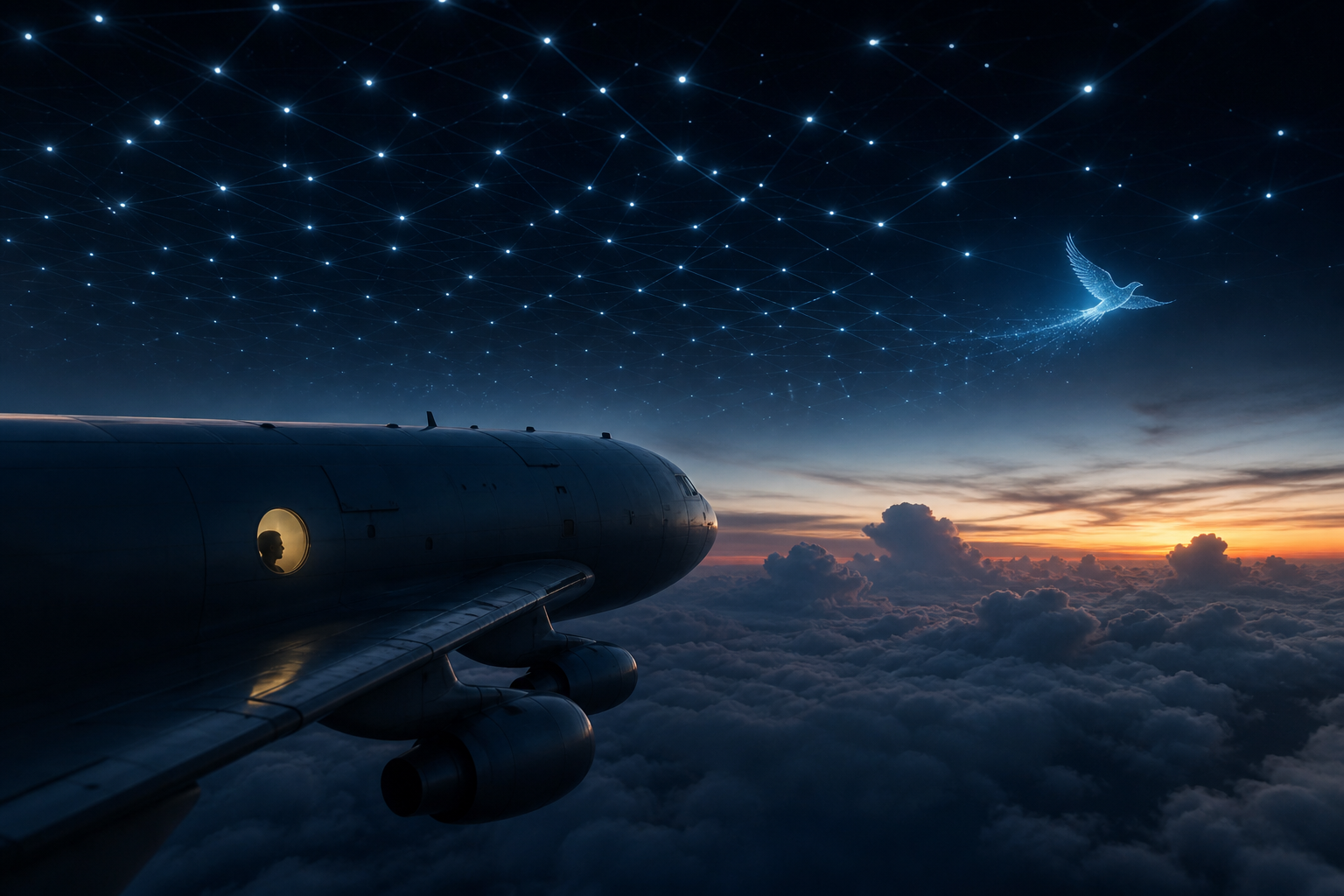
The flight was about thirteen hours. To save fuel, the cargo plane did not fly high; clouds spread beneath the wings like a continuous gray-white carpet. Through the porthole, Lu Yuan saw something that left him momentarily speechless.
Above the clouds, the sky was a near-black deep blue. In that deep blue, Starlink satellites were arrayed in a density visible to the naked eye—not discrete points of light, but a flowing, evenly distributed matrix of light, as if someone had scattered a handful of glowing sand across the heavens and a slow, invisible magnet was dragging them along. A hundred and twenty thousand. This number was an abstract concept on paper. But when you saw them with your own eyes, filling the entire dome—it was a visual shock that made you instinctively hold your breath.
The plane was now over the South China Sea. Lu Yuan pulled out his phone—Farhan had thoroughly modified it: physically removed every RF module related to Starlink interfaces, replacing them with a miniature SMA pigtail extending from the side of the body connected to a passive signal detection chip. No transmission capability, only passive monitoring on specific frequency bands. The screen lit up, showing an indicator that made him silent for several seconds:
「Starlink signal boundary detected · Current registration zone switching · International roaming protocol activated」
He was crossing an invisible border. Not a geographic border—a signal border. As the plane entered international waters, his terminal had automatically switched from the China region Starlink network to the international roaming channel. This switch required no manual operation, no confirmation click, not even user awareness—a hundred and twenty thousand satellites overhead were precisely tracking every aircraft’s flight path, pre-allocating channel resources for the service zone about to be crossed, completing seamless signal handover milliseconds before the boundary.
Lu Yuan turned his phone over and placed it face-down on his knee. He did not want to see that switch-success notification.
He remembered what his daughter had said—“Those stars are watching us.” At the time he told her stars could not watch, just to reassure her. But now, sitting by the window of a cargo plane, staring at that dense matrix of light points above, he suddenly felt his daughter might have been closer to the truth. Those satellites were indeed “watching”—with their optical sensor arrays, RF listening modules, and OrbitNet AI’s constantly running behavioral analysis models. They did not blink. They did not sleep. They did not forget.
He closed his eyes and forced himself to sleep in the low-frequency roar of the engines.
Lagos appeared outside the porthole in the morning mist.
The runway of Murtala Muhammed International Airport extended from a gray urban fabric, lined with low palm trees and rust-eaten tin roofs. When the plane touched down, the tires emitted a sharp screech, followed by violent shaking—the maintenance of this runway was clearly not up to Shenzhen Bao’an’s standard.
The arrival hall was packed. When Lu Yuan passed through customs, the officer in the green uniform glanced at his passport for less than two seconds before waving him through—Chen Wenfu’s Indonesian passport seemed to carry somedefault transit便利 at this West African port, or rather, customs here had little appetite for scrutinizing a seemingly legitimate passport. When Lu Yuan walked out of the arrival hall, the heat hit him like a wall—Lagos’s morning temperature was already approaching thirty-five degrees, the humidity so thick that breathing felt like drinking soup.
The person picking him up stood at the front of the crowd, holding a white cardboard sign reading “Mr. Chen.” A local youth who did not look over twenty, shaved head, wearing a faded green T-shirt printed with a blurred line of English—squinting, Lu Yuan made out “Data Is the New Oil” in its faded ghost. When the young man saw Lu Yuan looking, he broke into a bright smile, revealing a row of white teeth.
“Mr. Chen? Boss Amina sent me to pick you up. Follow me.”
His name was Joseph. He drove a twenty-year-old Toyota pickup, its bed loaded with a few coils of cable and a bottle of engine oil. Lagos traffic was famous for its eternal congestion, but Joseph knew every alley by heart. He would drive on the main road for no more than five minutes before cutting into a narrow dirt path, through a market of tin roofs, then squeeze out from what seemed like a dead end, bypassing the next bottleneck. He drove without navigation—or rather, his navigation was printed in his mind, composed of twenty years of accumulated street experience in Lagos.
“What business are you doing in Lagos?” Joseph asked, eyes fixed on a giant pothole ahead, skillfully steering around it.
“Communication equipment,” Lu Yuan said.
Joseph nodded, not pressing further. He pulled a bottle of water from under the seat and handed it to Lu Yuan—no label on the bottle, but the water was cold; he had probably just taken it out of the fridge before leaving.
The pickup drove along the coast for a while. The outline of Apapa Port gradually came into view—a steel jungle of container cranes and ship masts, the air above the port thick with diesel fumes mixed with sea salt. The containers stacked by the dock formed hills of colored metal—blue, red, green, white, layer upon layer, stretching beyond sight. Cranes moved slowly above them, like giant dinosaurs feeding.
Amina’s freight company was in an alley off the port, a three-story concrete building with light blue paint, mostly faded, exposing the gray cement underneath. The ground floor was a warehouse, roller door half-open, filled with goods of every shape—from car tires to bags of rice, from二手 generators to boxes labeled “Medical Supplies.”
Amina was waiting for them on the second floor.
She was shorter than she appeared in the holographic projection—about five foot three—but her bearing was so straight that her height was easy to overlook. She wore a dark blue one-piece work suit, the dove badge made of copper wire pinned to her chest, and a pair of military boots stained with oil. When she saw Lu Yuan jump down from the pickup, she did not speak, just nodded once, then turned and walked into the office.
The office was a complete contrast to the warehouse downstairs. No stacked goods, no scattered tools—just an old wooden desk, a swivel chair, a filing cabinet, and a safe standing in the corner. On the wall hung a paper nautical chart of the West African coastline, the paper already yellowed, the edges repaired with tape in several places.
Amina sat in the swivel chair, took out a bottle of palm wine and two glasses from the drawer. She filled both glasses halfway, sliding one to the other side of the desk.
“Sit.”
Lu Yuan sat down, took the glass but did not drink. The palm wine gave off a fermented, slightly sour sweet aroma.
“Farhan said you worked out SkyWalker’s void modulation approach,” Amina said. Not a question—she had complete trust in Farhan’s judgment. If Farhan said it was done, it was done.
“Farhan did the protocol layer and signaling layer,” Lu Yuan said. “I just filled in a noise reduction algorithm avoidanceapproach.”
“You filled in the key piece.” Amina picked up her glass, drank, and set it down. “SkyWalker has built a road through the desert. But you’re still missing one thing—the map.”
She stood up and walked toward the filing cabinet in the corner. The cabinet door had two locks—a combination lock and a key lock—requiring two people to open simultaneously. Amina entered the combination, then used the key hanging around her neck to unlock the second lock. The door opened, revealing not files but a storage compartment embedded in the cabinet body, containing a black briefcase.
The briefcase was placed on the table. Amina opened the latches and lifted the lid.
What Lu Yuan saw stirred a strange, almost nostalgic feeling—even though he had never seen these physical objects before.
It was a mechanical hard drive. 3.5-inch, the casing worn, the label faded to the point that the printed text was barely legible. The interface was old SATA, not the universal NVMe of today. The drive was sealed in an anti-static bag, surrounded by foam padding.
Amina carefully removed the drive from the bag and placed it on the table. Her movements—that precise, gentle handling of an object—made Lu Yuan realize this was not an ordinary hard drive. This was something that needed to be protected.
“Do you know the Pigeonnet?” Amina asked. This was the second time she had asked Lu Yuan this question.
“Farhan mentioned it. But I—”
“Follow me.”
Amina led him to the warehouse’s back courtyard. In the yard was a motorcycle—not electric, fuel-powered, the engine exposed, the tank covered in scratches. Fixed to the rear seat was a metal box, about the size of a food delivery box, but with an extra combination lock on it, and the walls much thicker than an ordinary delivery box.
“This is one node.” Amina patted the metal box. “From Lisbon to Casablanca—the data travels through a submarine fiber optic cable. An old cable not published in Starlink’s routing table, belonging to a telecom company that was acquired by Starlink but whose physical link was never dismantled. At each end of the cable is a physically isolated terminal—no IP address, no registered domain name, not connected to any public network. When the data reaches Casablanca—”
She opened the metal box. Inside was a standard 2.5-inch encrypted solid-state drive, mounted on a vibration-dampening bracket. Beside it sat a spare 18650 battery pack, strapped to the bottom of the box with zip ties, waterproofed with silicone.
“—it’s transferred from the fiber optic terminal onto this drive. Then a motorcycle courier carries it, heading south from Casablanca.”
Lu Yuan stared at the drive. Suddenly he understood.
“They have no Starlink interface. They emit no electromagnetic signals.”
“Correct.” Amina said. “Zero electromagnetic signals the entire journey. Casablanca to Marrakech, motorcycle. Marrakech to Nouakchott, off-road vehicle. Crossing the desert section of Mauritania—camel courier, about two hundred kilometers, no roads, no gas stations, no cell towers. From the edge of the desert to Bamako, then another vehicle to Abidjan—finally arriving in Lagos.”
She looked up at Lu Yuan.
“The entire journey is about two thousand kilometers. Average time: four days.”
Lu Yuan was silent. In his mind he compared two sets of numbers: SkyWalker’s QKD covert channel—Shenzhen to Lagos, twelve thousand kilometers, transmission delay roughly tens of seconds, one bit per second. The Pigeonnet’s physical transport—Lisbon to Lagos, two thousand kilometers, transmission delay four days, but capable of carrying tens of terabytes of data in one trip.
One as fast as light but as narrow as a needle. One as slow as a carrier pigeon but as wide as an ocean.
“Modern people can no longer understand this kind of speed,” Amina said, her voice carrying no self-mockery, only a calm statement. “On the Starlink network, they can download a movie in seconds, load a webpage in milliseconds. They think a network with latency over ten milliseconds is ‘too slow.’ But if you tell them that in inland Africa, there is a stretch of road without even cell signal—they won’t believe you, because the Starlink satellites overhead have already covered those places too.”
She closed the metal box and locked the combination lock.
“But that speed—it is speed given to you by someone else. Starlink can make you fast. It can also make you slow. It can raise your priority. It can also lower your priority. Today your account is Platinum; tomorrow it can change the rules and downgrade you to Copper. How do you appeal? The one you appeal to is the same entity—it is both player and referee.”
She turned to face Lu Yuan.
“My internet is slow. But you cannot turn it off. Because it’s not on satellites—”
She tapped the metal box with her fingertip.
“—it’s on people’s feet.”
Lu Yuan stood in the warehouse’s back courtyard, under Lagos’s burning sky. No Starlink satellite trails were visible—it was daytime, the naked eye could not see them. But he knew they were there. And now, before him, was a motorcycle cargo box containing a drive that had physically crossed two thousand kilometers.
Amina said the Pigeonnet was a relic of the old world. But Lu Yuan began to feel it was not a relic. It was a seed. A seed carefully preserved, buried beneath the soil, waiting for some winter to pass before sprouting again.
“The map you mentioned—” he said.
“Is below.”
Amina led him deeper underground.
The freight company’s basement entrance was hidden behind the innermost shelf in the warehouse. The shelf held bags of rice—thirty-two in total, fifty kilograms each. Amina moved them all by herself. Lu Yuan tried to help; she waved him off and said, “Get out of the way, I have my own rhythm.” When she moved the last bag, her breathing had not even quickened; she just wiped the sweat from her forehead with the back of her hand.
With the shelf moved aside, a steel floor door was revealed, a recessed handle flush with the cement floor. Amina crouched down, unlocked the floor door with a black key, then hooked two fingers through the handle and pulled upward.
An iron ladder leading down.
Below was an abandoned basement. Not the kind of engineering marvel the Data Party had renovated—it was a genuine, aged underground space. The walls were rough concrete, with white salt stains from water seepage on the surface. The air smelled of damp earth and decaying paper. In the corner stood a metal table with rusted legs, but on the table sat something that completely transformed the atmosphere of the basement.
A server.
Not a modern two-rack-unit device—it was a tower server, beige casing, several yellowed indicator lights and a floppy drive interface on the front panel. The model label read: FreeBSD 11.2-RELEASE. A sticker on the side of the chassis bore a marker-penned label: 「Lagos Node #1 · Last Sync: September 2040」
This machine had not had its operating system updated in over fifteen years. But it was still running. The power indicator on the front panel glowed green; the hard drive light flickered occasionally, like a living respirator.
“Seven years ago,” Amina said, standing beside the server, her palm resting on top of the chassis, like stroking the back of a quiet animal. “A friend brought it here. He was one of the last batch of core engineers to leave ICANN. The year Starlink fully took over the domain name system, he brought something out.”
She pressed the Enter key—the keyboard was an old mechanical one, plugged into the server’s PS/2 port. A command-line interface appeared on the screen. She entered a few commands, and text began to scroll.
Lu Yuan saw a world he had never witnessed firsthand but had read about in textbooks.
「Global Internet Core Topology Snapshot · Snapshot Timestamp: 2040-09-14T03:47:22Z」
Below was a list of entries:
- Root server configuration files — addresses of the 13 original root servers, 11 of which had been absorbed or shut down by Starlink, but 2 remaining whose physical locations and current status were marked as “unknown, presumed offline”
- Autonomous System Number Allocation Table — complete registration information from AS1 to AS130000, detailing every AS number’s owning organization, allocation date, routing policy
- IP Address Block Registry — the complete allocation tree of IPv4 and IPv6 addresses, from IANA to the regional internet registries, down to every specific subnet allocation
Lu Yuan’s gaze swept slowly across these entries. He was not a network layer person—his specialty was the physical layer and RF, not BGP routing protocols and DNS architecture—but he fully understood the value of what he was seeing.
This was the internet’s “organ donor card.”
If Starlink fell—for whatever reason—someone would need to know how to connect all this back together. Which physical machine housed the root servers. How to rebuild peering relationships between autonomous systems. Which jurisdiction controlled which IP address blocks. Without this data, rebuilding the internet would be like repairing a destroyed bridge without blueprints.
“He died six months after bringing this data out of ICANN,” Amina said. “Lung cancer. He had smoked for forty years; in his final year he couldn’t leave the oxygen mask. But while bedridden, he organized the entire dataset three times—first to verify the routing topology, second to validate the AS number ownership chain, third to write a troubleshooting manual, about four hundred pages.”
Her fingers entered a final set of commands. The screen switched to a global map—not the splendor of Starlink’s holographic projection, but a black-background, green-line, character-art-style map. All major intercontinental submarine fiber optic cables were rendered in ASCII characters, each cable annotated with its owner, capacity, and operational status.
“Most of these cables still exist physically. No one has dismantled them. But their operational rights have been gradually acquired by Starlink; all the cable terminal equipment now only responds to Starlink’s core network commands. If those terminal devices were reinitialized with a correct configuration file— theoretically—they could resume independent operation.”
She looked at Lu Yuan.
“If one day Starlink falls—or more likely, Starlink decides to disconnect you from those cables—someone will need to know how to use this data to rebuild the internet.”
Lu Yuan stood before that server, the green characters jumping in his pupils. He suddenly understood his position in the whole blueprint. He had thought he was doing “destruction”—breaking Starlink’s billing system, bypassing Starlink’s authentication mechanism, tearing through Starlink’s protocol layer. But his skills—signal cloning, SkyWalker, void modulation—their true meaning might not be to destroy anything.
They were meant to preserve another option.
A path for the internet to continue existing outside Starlink’s shadow. A backup, distributed network that required no permission to access. A machine that never billed, never censored, never cut off.
“You asked me why I came to Lagos,” Lu Yuan said, his voice producing a faint echo on the basement walls. “It’s not because Farhan sent me.”
Amina looked at him, silent.
“It’s because I wanted to see with my own eyes—in this world covered by a hundred and twenty thousand satellites—what things are still truly alive.”
He turned to the server. Those fiber optic routes rendered in ASCII characters still flickered quietly in green on the screen. He reached out and touched the surface of the server chassis—the plastic was warm, the residual heat of a motherboard that had been running for over a decade. This machine was old enough—old enough that when it was born, the internet had not yet been wrapped around by one company’s satellites. Old enough that its system still preserved the skeleton of an era of “completely free global interconnection.”
Lu Yuan withdrew his hand from the chassis.
“Do you know what I’m most afraid of?” he said.
“What?”
“Not that Starlink won’t fall. It’s that after Starlink falls—no one remembers how to speak in a world without Starlink.”
After he said this, the basement was silent for a long time. Overhead, the port cranes of Lagos continued to operate, containers being lifted and set down, producing dull metallic impacts. Joseph started the Toyota pickup’s engine upstairs, the exhaust pipe emitting a low growl. All these sounds, transmitted through concrete and earth to this underground space, had become very faint, like echoes seeping through from another world.
Amina did not speak. She turned off the server’s monitor and pushed the keyboard back into place. Then she took a key from her pocket and handed it to Lu Yuan.
The key was steel, worn to a sheen, its teeth cut in an irregular pattern—not an ordinary pin-tumbler key, but an old-style tubular key, rare these days. A small faded label hung from the key ring, with a string of numbers written in ballpoint pen: /etc/resolv.conf
“If one day you need to use that server’s data—you know how to find it,” she said.
Lu Yuan closed his hand around the key. The surface of the steel key had the cool, solid texture unique to physical objects—completely different from the digital information floating in holographic projections, different from the photons flying through fiber at the speed of light. It was a material witness—proof that the internet was not just data, not just signals, not just a hundred and twenty thousand points of light in satellite orbit.
It was also something that could not be shut down, deleted, or cut off.
Lu Yuan placed the key in his inner pocket and zipped it closed.
“There’s one more thing I want to ask you,” he said.
“Go ahead.”
“Why are you guarding these things? You’re not an engineer. You’re not from ICANN. You’re a—” He searched for a word he was not sure was accurate, “—freight company owner.”
Amina shifted her gaze from the server to Lu Yuan. Her expression did not change, but she was silent for a moment, and the length of that silence made Lu Yuan realize he had touched something very deep.
“When I was twenty-one,” she said, “my country experienced a communications blackout. Not a network outage—the network became something you could only read, not write. You could receive information, but you could not send it. You could read the news, but you could not comment on it. You could receive messages from friends, but every message you sent would pass through a seven-day review period on the government’s server—if it did not pass, the recipient would never receive it. You never knew whether your message was delayed or blocked, because the system would not tell you.”
She paused.
“At that time, we were not using Starlink. We had our own terrestrial network. But I heard that day about a technology that could allow any government to shut down anyone’s right to speak at any time. It had nothing to do with who owned the network—it had everything to do with who owned the protocol.”
Her gaze fell on the server.
“Later, Starlink came. They said this technology could never be censored—because the satellites were above you, no one could turn off something in the sky. But Milan Vojnović sat in his Belgrade office for a year and wrote less than three thousand lines of code, changing Starlink’s entire QoS control module from ‘optimization suggestion’ to ‘mandatory enforcement.’ And then there were quotas. There were tiers. There was the data tax.”
She looked up at Lu Yuan.
“So I am not an engineer, you are right. But I have seen too many people lose the ability to speak. I just—did not want that to happen again.”
She walked around to the back of the server and unplugged the power cable. The machine let out a soft, descending whine of the fan, the indicator lights shifting from green to orange to off. The entire basement fell into a pure silence, broken only by the sound of their breathing.
“Let’s go,” Amina said. “The sun is about to set over Lagos. Your daughter is waiting for you.”
As Lu Yuan climbed the iron ladder, he paused on the last rung.
He looked back at the basement. The server sat quietly on the metal table, like a sleeping tomb guardian. Inside its hard drive, a blueprint of the old world lay arranged in zeros and ones, waiting for a wake-up command that might never come.
He climbed back to the surface.
The moment he returned to sunlight, the Lagos dusk was descending. The sky was dyed a color between orange-red and deep purple, a few wisps of cloud hanging low like burned cotton. The horns of cargo ships echoed faintly in the distance, seagulls circling above the container cranes. Everything looked like the most ordinary tropical port at sunset—but Lu Yuan’s perspective had changed. He could see the satellites overhead. He could see the server in the basement. He could see the encrypted hard drive in the metal box of Joseph’s pickup, crossing the African continent.
Two internets were running simultaneously in this Lagos dusk. One overhead, transmitting every precisely billed data packet at the speed of light. Another on the ground, carried in metal boxes, tied to motorcycles, loaded on camels, crossing desert and forest at less than thirty kilometers per hour.
One did not care about speed. Only about arrival.
Lu Yuan settled into the passenger seat of the pickup. Joseph started the engine, pulled the unfinished bottle of water from under the seat, and handed it to him. Lu Yuan took it and drank; the water was no longer cold, but he did not mind.
“The airport,” he said.
Joseph nodded, put the truck in gear, and the pickup merged into the traffic of Lagos’s evening bustle. Outside the window, Africa’s largest city was coming alive—market lights flickered on one by one, white smoke rose from roadside barbecue stalls, music poured from speakers on every corner, blending into a continuous, tireless roar.
Lu Yuan leaned back in his seat, his fingers touching the cold steel key through the fabric of his inner pocket.
He remembered his daughter asking for a wooden carved elephant.
He thought he might be able to find one at the airport duty-free shop.