Chapter 12 · Reunion and Parting
Lu Yuan stayed in Lagos two extra days.
The original plan was to catch a cargo flight back to Shenzhen. But Amina said a fresh batch of encrypted firmware needed ground-side field testing, and the number of people along the entire West African coastline who could read QKD channel data could be counted on one hand — she was one of them, but she admitted she was getting old and her fingers weren’t as steady anymore. Lu Yuan had no reason to refuse. He sent Sister Shen a message through an encrypted text channel about his daughter. The reply was brief: “She’s fine. Medicine taken on time. Asks when Daddy’s coming back.”
He replied: “The day after tomorrow.”
Then he locked his phone in a Faraday bag and followed Amina’s man Joseph to the Pigeonnet node in the dock district.
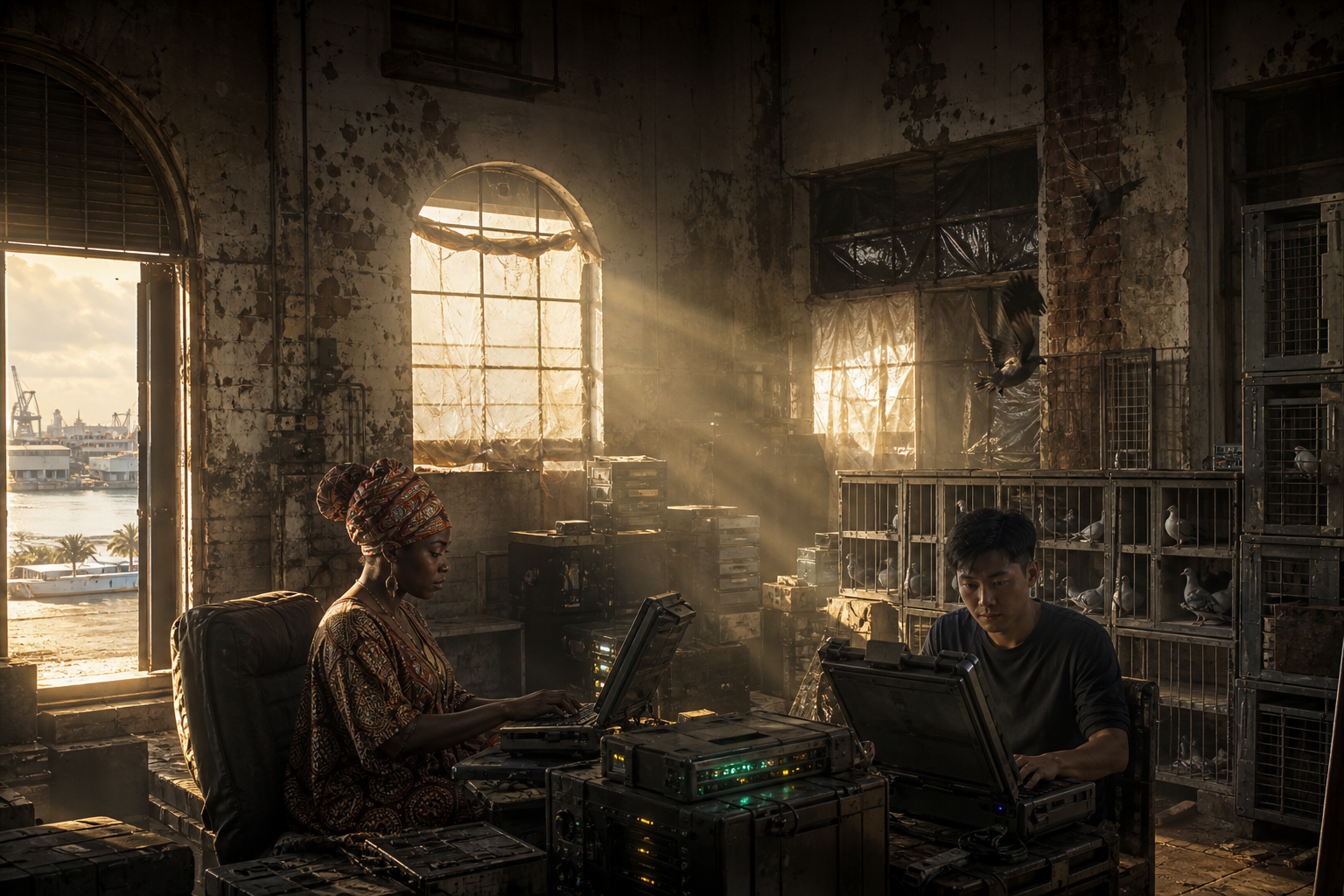
The node was in a colonial-era brick building, about four hundred meters from the container yards of Apapa Port. The white paint on the exterior had peeled away in large patches, revealing brickwork eroded to brown by the tropical humidity. Most of the second-floor windows were broken, temporarily sealed with plastic sheeting and tape. From the outside, the building looked exactly like any abandoned or semi-abandoned warehouse in the Lagos port district — in fact, it was an abandoned warehouse, until a year ago when Amina’s people rented it with cash and partitioned a temperature- and humidity-controlled workspace on the ground floor.
The workspace held three pieces of equipment: a modified Starlink ground station terminal (its casing removed to expose the circuit board, secured to an acrylic plate with zip ties), a signal analyzer (one generation older than the one Lu Yuan had borrowed in Huaqiangbei), and a cooling fan running with a low-frequency hum, aimed at a black metal box roughly the size of a shoebox.
That metal box was the new SkyWalker protocol firmware test sample — not a prototype like the one Farhan had in Shenzhen, but a second unit Amina had independently replicated in Lagos using locally available components. The casing was hand-welded, less refined than Farhan’s, but more robust — as if twenty percent extra solder had been used to ensure the joints would never loosen.
Lu Yuan crouched in front of the machine, measuring the power module’s output ripple with a multimeter. Real-time spectrum data scrolled across the signal analyzer’s screen. He watched the curves in his peripheral vision while adjusting a trimmer capacitor with his fingers, trying to push the phase noise of the local oscillator down within SkyWalker’s acceptable range.
He was so focused he didn’t notice the light at the doorway dim.
“The capacitors in your power module are standard aluminum electrolytic — poor high-frequency characteristics. Switch to tantalum. You’ll drop the ripple by another order of magnitude.”
The voice was female, with a slight Eastern European accent, as flat as stating engineering common sense already verified a thousand times.
Lu Yuan looked up. A white woman stood in the doorway, mid-twenties, brown hair tied in a low ponytail, wearing a dark gray quick-dry T-shirt and cargo pants. She carried a black canvas tool bag with a coil of cables and a handheld spectrum analyzer strapped to the outside. Her skin was tanned a light wheat color by the tropical sun; a pair of dust goggles sat pushed up on her forehead.
She didn’t look like one of Amina’s employees. But she clearly wasn’t a random passerby who’d wandered into an abandoned warehouse — the handheld spectrum analyzer on her back had been modified, a non-standard low-noise amplifier module added at the antenna port. Not a commercial configuration.
“You are?” Lu Yuan asked, pulling the multimeter probes off the board.
“Mia,” she said, walking into the workspace and setting her tool bag on the table. “From Berlin. Amina sent me to pick up a copy of the firmware sample.”
Lu Yuan watched her take the spectrum analyzer from her bag and connect it to a small decoder he’d never seen before — the decoder’s casing was 3D-printed, with support material remnants still visible on the sides, but the internal circuit layout was exceptionally tidy, the routing more disciplined than most hobbyist designs he’d encountered.
“You’re with the Data Party too?” he asked.
“Sort of.” She said the word with a strange vagueness, like a label she didn’t dislike but didn’t fully embrace either. “I’m a liaison for the Berlin branch. You probably know Farhan — he’s one of our core people.”
“Farhan helped me,” Lu Yuan said, asking nothing more.
He turned his attention back to the metal box. The multimeter reading was still unsatisfactory — power ripple about twelve percent above the SkyWalker threshold. He switched off the meter and reached for the tool box on the table, intending to swap in a different filter capacitor.
“Your reference ground is wrong,” Mia said from behind him. She hadn’t moved closer — she was still standing by her tool bag, her eyes on the circuit board in front of him. “You clipped your reference ground to the power input negative terminal when measuring ripple. But SkyWalker’s modulation circuit is extremely sensitive to reference ground placement — you should clip it to the modulation chip’s ground pad. About a three-millivolt drop difference.”
Lu Yuan paused. He didn’t turn around, but he removed the reference ground clip from the power negative terminal and attached it to the modulation chip’s exposed ground pad. He measured again.
The ripple reading dropped — landing just within the SkyWalker protocol threshold.
He set the multimeter down and turned to look at her. It occurred to him that in the few moments since she’d walked in, she had accurately diagnosed what problem he was debugging, what measurement method he was using, and that the wrong measurement method had created a problem that didn’t actually exist.
“You’re very familiar with this system,” he said. It wasn’t a question.
“I’ve read Farhan’s source code,” she said, her tone flat, but she added, “Mostly I reconstructed it myself — Farhan’s comments are sparse, and his coding habits aren’t great.”
Lu Yuan didn’t respond. He quickly assessed the weight of that statement in his mind. Farhan’s SkyWalker protocol source code was roughly forty thousand lines, including the QKD channel modem, the void encoder, the error correction layer, and the routing interface. Any one of these components required deep concurrent understanding of quantum optics, CDMA physical layer, and embedded systems programming to reconstruct independently.
At Huawei’s 201 Lab, he’d seen some young geniuses. But this person — she looked no older than twenty-six — said she’d “mostly reconstructed it herself” like it was nothing remarkable.
“What do you do in Berlin?” Lu Yuan asked, changing the subject. He crouched back down to organize the cables on the workbench, feigning casualness to mask his curiosity.
“Liaison. Technical coordination between the Berlin and Lagos pigeon lines. Farhan handles R&D in Shenzhen, Amina manages logistics and hardware production in West Africa. Someone needs to sync the information flow between the two lines without triggering Starlink surveillance.” She opened the 3D-printed decoder and connected her handheld spectrum analyzer. “That’s my job.”
She pressed the analyzer’s measurement key. Rows of decoded data began scrolling across the screen — QKD photon arrival time difference noise void patterns, successfully extracted by her device and translated into binary sequences. The first complete data packet displayed a line of text:
“SKYWALKER · LAGOS NODE #1 · SIGNAL ACQUIRED · SNR 11.7dB”
“Better signal quality than your prototype,” she said, the corner of her mouth lifting in a trace of something that was barely a smile. “Your capacitor decision was correct.”
Lu Yuan looked at the SNR reading. 11.7dB — about 1.2dB higher than what Farhan had measured in Shenzhen. The improvement was within his expectations, but seeing it independently confirmed by another device loosened a knot of doubt about SkyWalker’s viability.
“Where did you learn QKD?” he asked.
Mia switched off the spectrum analyzer. She didn’t answer immediately. She put the analyzer back in her tool bag, zipped it up, and then said, her voice slightly lighter than before:
“My father worked in communications.”
“What did he do?”
“Used to teach communications engineering at the University of Belgrade. Later he did protocol architecture for a company.”
“Did you learn from him?”
Mia’s hand stopped on the zipper pull of her tool bag. It was a brief pause — less than a second — but Lu Yuan caught it.
“He’s dead,” she said. Sharp and clean, like a piece of metal cut in one stroke, the edge perfectly smooth. “So a lot of it I taught myself.”
Lu Yuan didn’t press. He’d seen this way of speaking before — at Huawei’s 201 Lab, some engineers used the same tone when talking about colleagues who’d been laid off. Not coldness, but a declaration that the topic’s conversational quota had been exhausted.
He turned back to the metal box. The trimmer capacitor offered a faintdamping feel under his fingers. He adjusted it to the optimal position, secured it with the locking nut, and picked up a marker to make a small mark on the edge of the circuit board — a tiny “OK.”
“Thanks for the tip earlier,” he said. “The reference ground.”
“You’re welcome.”
The workspace fell quiet. Only the cooling fan’s low hum and the occasional horn from the distant harbor filled the space. Lu Yuan adjusted the routing parameters of the SkyWalker data packets. Mia sat on a folding chair beside her tool bag, a tablet on her lap, sketching something with a stylus — not a circuit diagram, but a waveform, the time-domain plot of some modulated signal.
She’d draw a few lines, stop, study it, delete, redraw. Over and over.
Lu Yuan didn’t ask what she was drawing. It wasn’t the right occasion for casual conversation — they’d just met, sharing a small workspace, keeping the cautious distance typical of a first collaboration.
But in his mind, he tagged her: excellent technical intuition, unclear background, and a grasp of QKD channels that seemed mismatched with her age.
He thought of his own father — a lifelong communications lineman for the post office, who’d never touched quantum optics. He thought of the rare common ground between them: signal quality, antenna placement, why the TV would snow in the rain. Those conversations had seemed unremarkable at the time, but now, in a sweltering workspace in the Lagos dock district, he suddenly realized those conversations were an interface he could never replicate — one that was old, unencrypted, and required no authentication.
He shook off the thought and continued working.
That evening, Lu Yuan returned to Amina’s shipping company office.
The upstairs office had been temporarily converted into a rest area — a folding cot, a standing fan, a power strip plugged into an insect repellent diffuser. He’d just finished washing his face when Amina knocked and entered.
She carried two cups of tea — not palm wine, but real tea, black, with a splash of condensed milk. She set one in front of Lu Yuan and sat down across from him on a creaking wicker chair.
“That girl from today,” Amina said, taking a sip of tea, her tone as calm as if she were discussing the harbor tide levels. “You spoke with her?”
“A few words,” Lu Yuan said. “She helped me with something — a power measurement issue.”
“She’s technically very good, isn’t she?”
Lu Yuan nodded. Amina held her teacup, her gaze settling on the floating tea leaves as if weighing something.
“Do you know who she is?”
Lu Yuan shook his head. Amina looked up at him. Her eyes were very bright under the warm yellow bulb — not the brightness of excitement or tension, but the steady gleam that comes before an important revelation.
“Milan Vojnović’s daughter.”
Lu Yuan’s movement froze. His hand, holding the teacup, stopped in midair — neither setting it down nor bringing it to his lips.
“What?”
“Mia Vojnović. Milan’s only child. Born in Belgrade, bachelor’s at ETH Zurich, and then — as far as we know — she cut ties with her father. Joined the Data Party Berlin branch three years ago under a pseudonym — first name only, no surname. She thinks we don’t know her background.”
Amina paused, took a sip of tea.
“But we know. We’ve known from the beginning.”
Lu Yuan set the teacup on the table. The warmth of the tea penetrated through the ceramic into his fingertips, but he barely felt it.
“Does she know you know?”
“No. At least, I don’t think so. She thinks she’s hidden it well — doesn’t use her father’s surname, modified her accent, filled out minimal identity information on the Data Party membership form. But Milan Vojnović’s daughter appearing in the Data Party isn’t something that can be kept from everyone.”
Lu Yuan was silent. He remembered that clipped answer from the afternoon — “He’s dead.” — and the brief pause of her hand on the zipper pull. A twenty-six-year-old woman, disposing of her entire father in a crisp lie followed by a quick subject change. She must have practiced that sentence many times, drilled until the tone sounded completely natural, until her expression showed no crack afterward.
“Where did her technical skills come from?” he asked.
“Stolen,” Amina said, setting down her teacup and folding her hands on her knees. “Milan had a study at home. The shelves held all his technical notes — from his doctoral thesis drafts at the University of Belgrade, to the first drafts of Starlink’s first-generation network protocol, to the later third-generation QKD architecture design documents he wouldn’t let her see. They say she started sneaking looks when she was about fourteen, when her father was away. Copying, photographing, writing down formulas she didn’t understand in notebooks, and using his office terminal to look things up when he was on business trips.”
“Milan didn’t know?”
“Milan probably knew.” Amina’s eyes held a complex expression, mixing understanding with caution. “But a man like Milan — he built a wall. And then he left a gap in the wall, just wide enough for one person to crawl through. The gap happened to be at the height his daughter could reach. Do you think that was coincidence?”
Lu Yuan didn’t answer.
“Her understanding of the QKD channel — that side channel — the source of her discovery is right there. She read scattered technical fragments without context in her father’s notes, then pieced them together in her own way.” Amina paused. “She doesn’t know that side channel was left there deliberately by her father. She thinks she discovered a vulnerability on her own.”
The room went quiet. The oscillating fan on the table swept warm, humid air back and forth at a fixed rhythm. Outside, the Lagos night breathed slowly through the sounds of crickets and distant diesel generators.
Lu Yuan’s finger traced the rim of the teacup slowly. He was thinking about one thing — his daughter, Zijing.
If one day his daughter stood in a camp he completely opposed, doing things against him, using all her talent to fight everything he’d built —
Could he move against his own daughter?
He knew the answer.
No. Just imagining the scene made his chest tighten. It was a contradiction that could not be resolved through reason. Milan Vojnović had designed a protocol architecture that trapped seven billion people in a billing system, but he had left a door only his daughter could open. Not because he wanted her to open it — because he couldn’t shut it completely.
Amina watched his silence and didn’t press further. She stood up, took her empty cup, and walked toward the door. Before pulling it open, she paused.
“She doesn’t know you’re Lu Yuan — she only knows you’re an RF engineer from Shenzhen sent by Farhan. She’ll come back tomorrow to pick up the final firmware packet. How you handle your interactions with her is your own decision. I have only one suggestion —”
She turned to look at him.
“Don’t define her by her identity. She has already chosen which side she stands on. Who her father is, and who she is — those are two different things.”
She closed the door behind her. Her footsteps receded across the wooden corridor floor, absorbed by the sound of another door opening and closing at the end of the hallway.
Lu Yuan sat by the folding cot, the light still on. He pulled his phone from his pocket — no signal. The Faraday bag’s isolation had rendered the device completely offline. He didn’t turn it on. He just held it, watching the blurred reflection of the ceiling bulb on the screen.
He thought of Zijing. He thought of the look in her eyes when she’d held his hand and said, “Then you have to come back.” He thought of the question — if one day his daughter stood on the opposite side, what would he do.
He didn’t know what he would do. He only knew that he was already afraid of the answer.
The next evening, as Lu Yuan was running the final firmware test in the workspace, he saw something he wasn’t supposed to see.
He’d come back for his multimeter, which he’d left behind. The workspace door was unlocked — in the Lagos port district, locking didn’t make much difference; anything truly valuable had already been emptied by Amina’s people. He pushed the door open and found Mia was still there. She had her back to the door, sitting on the creaky swivel chair at the workbench. A desk lamp cast its cone of light across a handwritten letter spread out in front of her.
Paper. A physical letter. Not email, not a message — something written with actual pen and paper. In this era, only two kinds of people still wrote physical letters: nostalgic people, and Pigeonnet users. Mia was clearly the latter.
By the time Lu Yuan saw the letter, it was too late to back out. He stood in the doorway, the door half-open, the desk lamp illuminating the recipient address on the envelope — written in ballpoint pen, the handwriting neat and restrained, the spacing between each letter as even as typesetting:
“Belgrade · Sava River · Recipient: Ana Vojnović”
Ana Vojnović.
Milan’s wife. Or ex-wife — Lu Yuan didn’t know their current marital status, but he remembered the name. He’d seen it once in the Data Party’s internal files, in Amina’s intelligence records: a note that Milan Vojnović and his wife Ana were separated but not formally divorced, that Ana still lived in the old Belgrade apartment, receiving anonymous letters from Berlin at regular intervals.
Mia’s letters.
The letter Mia was writing hadn’t been sealed yet. The paper lay open on the table. Her hand holding the pen hovered above it, the nib not yet touching for the final few lines. She heard the door and turned her head. Her expression shifted from focus to a brief blankness — not anger, not panic — the pause of someone caught revealing a side of herself she never showed.
Lu Yuan should have retreated. He should have closed the door, pretended he’d seen nothing, gone back upstairs to sleep.
But he didn’t.
“That letter is to your mother?” he asked.
His voice was softer than he’d intended. Not probing, not judgmental — just confirmation.
Mia looked at him, at the edge of the desk lamp’s glow, her expression slowly shifting from that brief blankness to something more complex — as if she was deciding whether this person, whom she’d known for less than two days, was worth an honest answer.
In the end, she didn’t answer. She just lowered her head again and wrote the final few lines on the paper. Then she folded the letter, slid it into the envelope, licked the gum strip, and sealed it shut.
She didn’t put the letter away. She placed the envelope on the table, pressed both hands on top of it, and looked at Lu Yuan.
“Yes,” she said. “To my mother.”
Lu Yuan stood in the shadow of the doorway. He didn’t walk in, and he didn’t walk out.
“You don’t need to —” he began, but Mia cut him off.
“You won’t tell Amina.”
It wasn’t a question. It was a statement, carrying a trace of uncertainty that the speaker was trying very hard to suppress.
“I won’t,” Lu Yuan said.
He paused, then added something he didn’t know why he was saying:
“Your mother is still in Belgrade?”
“Yes. She refuses to leave. She says it’s the place where she met my father — she wants to wait for him there.”
Mia’s voice was flat. But on the word “wait,” there was an almost imperceptible tremor in her vocal cords — so small it would be completely missed if you weren’t listening carefully.
“And you?” Lu Yuan asked. He didn’t really know what he was asking — why she left, why she still wrote letters, what —
Mia looked down at her hands.
“I’m in Berlin. I don’t want to be his daughter anymore. But I haven’t learned how not to be.”
She said it without looking at Lu Yuan. Her eyes were fixed on the envelope, on the words “Ana Vojnović” in the recipient line — as if she were speaking to those words, not to him.
The workspace was quiet for a long time. The cooling fan kept running in the corner, tireless and indifferent, like a timer.
“Can I ask you a question?” Lu Yuan said.
Mia didn’t nod or shake her head, but she waited.
“You’ve already cut ties with your family. You’re fighting against your father — if he finds out what you’re doing in the Data Party, he can use Starlink to lock you up. You know that. But you still write to your mother every week, asking her to tell your father that you’re fine.”
Lu Yuan paused.
“When you write those letters — who are you writing to? Your mother? Or him?”
Mia didn’t answer.
She looked down at the letter on the table, then stood up, put it in her bag, and zipped it shut.
“Good night,” she said. Then she walked around the workbench, past Lu Yuan, pushed open the door, and disappeared into the darkness of the corridor.
Her footsteps faded across the wooden floor — similar to the sound of Amina leaving the night before, but lighter, like someone trying not to disturb anything with her steps.
Lu Yuan stood alone in the empty workspace. The desk lamp was still on, its cone of light still covering the area where her hands had pressed against the table. A faint impression remained — the four corners of the envelope had left shallow indentations on the wooden surface.
He didn’t turn off the light. He picked up his forgotten multimeter and left the workspace.
The corridor was long. Half the ceiling bulbs were dead; shadow and light alternated across his face in a broken rhythm. As he walked, he thought about the contents of the letter — what was the last sentence Mia hadn’t finished writing. What she would say to her mother. Whether the line “Tell him I don’t hate him” was already written, or still waiting at the tip of the pen for a phrasing she hadn’t yet found.
He thought of his daughter. Zijing was five, still in the stage of drawing butterflies with crayons. She still had a long childhood ahead of her. She still had enough time to learn what hatred was, what forgiveness was, what it meant not to forgive but still not hate.
He didn’t want her to learn those things too quickly.
He reached the end of the corridor and stopped at the corner. Through a window without glass at the far end, he could see the Lagos night sky. The clouds were thick, hiding all stars — both the real ones and the Starlink satellites — behind a low-hanging blanket of rain clouds.
He stood there for a while, then turned back to his room.
The next morning, before leaving Lagos, Lu Yuan did one thing. He ran into Mia on the second-floor corridor of the shipping company office — she was packing the 3D-printed decoder into her tool bag, preparing to head to the next node. She looked like she hadn’t slept all night, faint shadows under her eyes, but her movements were still precise and efficient.
“Mia,” Lu Yuan called out.
She stopped and turned to him.
“About yesterday’s letter —” he began.
Her expression tightened slightly.
”— I didn’t read the contents,” Lu Yuan said. “But if you need someone to get it onto the Pigeonnet line — I have a channel. Amina won’t see the content through her node network. Pure physical relay.”
Mia looked at him. The assessment lasted about three seconds. Then she unzipped the side pocket of her tool bag, took out the letter, held it in her hand for about a second, and handed it to him.
Lu Yuan took the letter. The paper still carried the residual warmth of her palm.
“Thank you,” she said. Very softly.
Then they parted. Mia walked toward the port district, her white T-shirt gradually contracting into a smaller and smaller dot against the gray-green harbor backdrop. Lu Yuan stood on the steps of the shipping company office, placing the letter in the inner pocket of his backpack — right next to the tubular key Amina had given him.
Two things, both needing to be delivered.
One was the skeleton of an old internet. The other was the unspoken thoughts of a daughter who didn’t dare send her words directly.
They sat side by side in the inner pocket of his chest — separated by fabric, by zippers — each one silent in its own way.
He returned to the airport.
While queuing for security, he suddenly remembered — he’d promised his daughter he’d bring her a carved wooden elephant. He found one on the last shelf of the airport duty-free shop, palm-sized, carved from ebony, its trunk raised upward. The craftsmanship wasn’t refined, but the lines were simple, carrying an awkward liveliness. He bought it and packed it in his carry-on.
Four hours later, the cargo plane lifted off from Lagos. The African coastline outside the window shrank steadily and finally disappeared beneath a white blanket of clouds. Lu Yuan took the wooden elephant from his bag, set it on his knee, and touched the fine texture left by the carving knife on the elephant’s back.
He was thinking about something that had occupied him since last night.
Mia said she hadn’t learned how not to be his daughter.
He didn’t know if he would one day face the same question — whether Zijing, when she grew up, would stand in a position he couldn’t understand at all, using the things he’d taught her to oppose the things he protected.
He hoped not.
But he also knew that Milan Vojnović had probably once hoped the same thing.