Chapter 22 · Open the Door
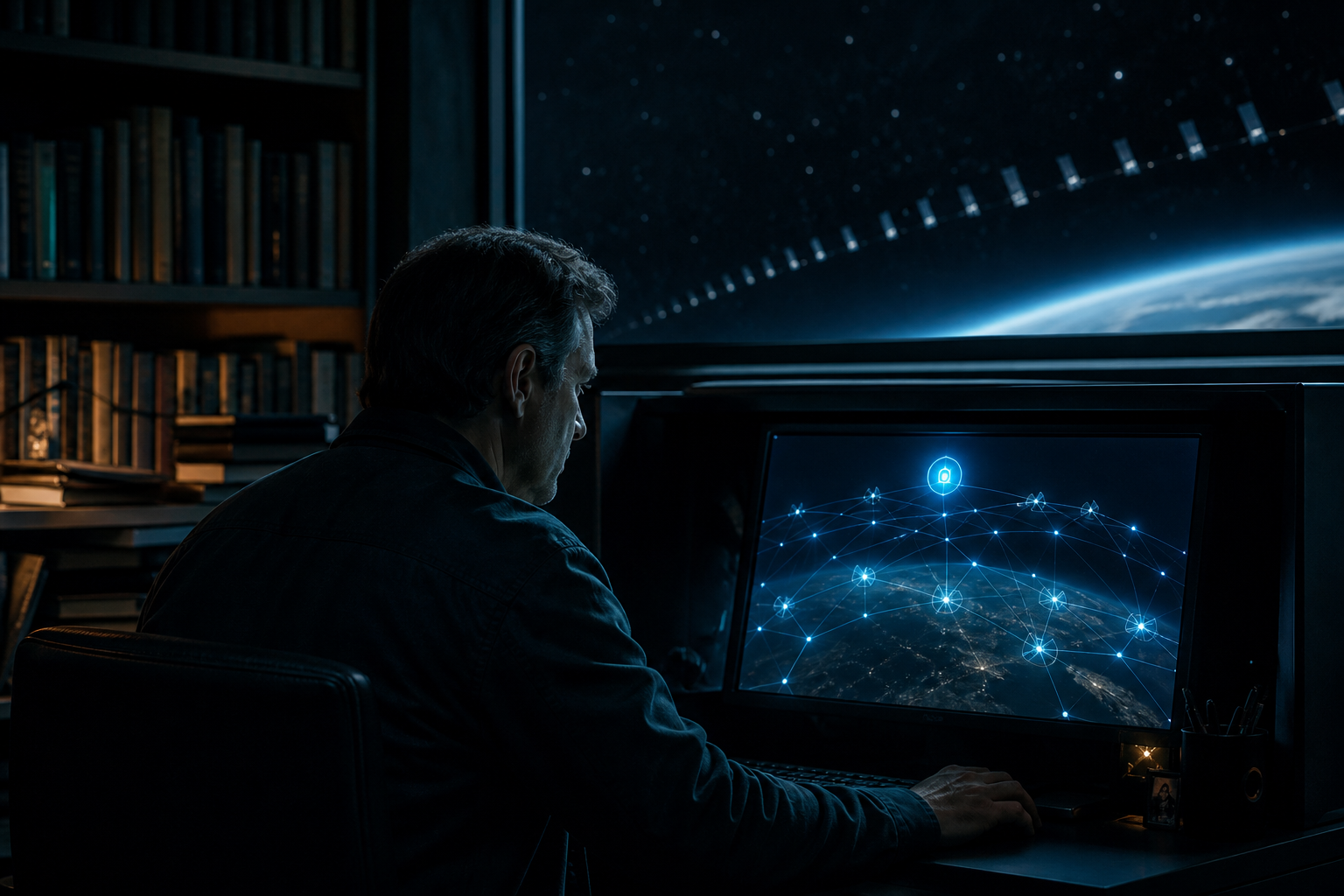
Milan sat in his San Francisco office for about four minutes — during those four minutes he didn’t touch the keyboard, didn’t check any data, didn’t even blink very many times. At the upper right corner of his screen, the blue icon was still lit, steady, like a signal light that had already been connected.
After four minutes, he sat up straight.
He opened a terminal window — not his everyday work environment with Starlink’s highest-authority certificate, but a personal machine that had never been associated with any company device. A small workstation hidden behind the bookcase in the corner of the office, a black case with no brand logo, connected to a backup fiber optic line independent of the Starlink network. The monthly fee for this fiber was deducted from his personal account, the bill sent to his old Belgrade address, signed for by Ana and scanned to his private email.
On this machine ran a program he hadn’t opened in many years — an ancient command-line tool written in Python 3.8, with a simple function: sending management commands to several specific nodes of Starlink’s core routing layer through a set of hardcoded API interfaces. These API interfaces had long been marked as “deprecated” in Starlink’s official documentation, but Milan had never allowed them to be completely removed — he kept them in the firmware under the pretext of “backward compatibility testing requirements.”
This set of interfaces, combined with the logical address space just activated by the nested entry point, formed a bridge from the external connection to the Data Haven autonomous domain.
An observer’s seat.
Milan typed several commands on the keyboard. Not to open the backdoor — the backdoor had already been opened by that old-model satellite’s S-band receiver. What he was doing was configuring his own access point — a complete path starting from this black workstation, passing through four relay nodes and two protocol conversions, finally reaching that 1 KB address space.
He saved the path configuration as a file with a nondescript name: bkup_route_7.cfg.
Then he opened another program — a text editor. He didn’t examine what data was in that address space — SkyWalker’s first data packet had already been written into it within the first few seconds after the nested entry point was activated, but he didn’t intend to read its content. At least not now. He typed a few lines in the editor, saved them as a text file, and wrote them into Data Haven’s autonomous domain through that path.
Not as a command. Not as a rule. As a message.
After writing this, Milan leaned back in his chair and closed his eyes for a moment. The afternoon sunlight in San Francisco leaked through the gaps in the blinds, casting a warm orange glow across his eyelids. He didn’t need to open his eyes to know — in some underground equipment room in this city, the machine running the ancient FTP server had already received a dial-up connection from Berlin. On his screen, the nested entry point icon he had looked at for so many years had turned to activated blue.
He opened his eyes.
He opened the encrypted text channel to Lu Yuan — not the one he monitored, another one, one he had just built, for direct communication between him and Lu Yuan only. His cursor blinked in the input field for a moment, and then he started typing.
He could let them into Starlink’s underlying routing layer. The nested entry point was already activated, Data Haven’s first autonomous domain already theoretically existed. But he needed to confirm one thing — confirm that the people walking through this door understood what this door meant. What he needed wasn’t power — he needed to know, if this door opened in the wrong direction, whether anyone could close it.
His fingers moved across the keyboard. He didn’t type quickly; there was a brief pause between each word, as if carefully weighing the weight of every character.
「I can let you in.」
The cursor blinked at the end of the sentence. He paused, then continued typing.
「But I’m coming in too.」
After typing these words, he stared at the screen. For a moment he wanted to add an explanation — not because I don’t trust you, but because if you fail, I need to know how to shut it down. But he didn’t add it. He let those words exist alone on the screen, waiting for the other side’s response.
On the highway from Shenzhen to the abandoned ground station, the silver-gray Wuling Hongguang was driving north at a steady speed. Lu Yuan sat in the passenger seat, Farhan driving. For a long time, no one spoke in the cabin. The aluminum case in the trunk occasionally made a faint metallic clatter as the car bumped over uneven road.
Lu Yuan’s phone vibrated.
He looked down. Then he turned the screen toward Farhan.
Farhan glanced at it, then returned his eyes to the road. The muscles in his jaw tightened slightly — one of the few emotional signals he ever displayed.
“He might sell us all out,” Farhan said.
Lu Yuan didn’t answer immediately. He looked out the window at the roadside vegetation flowing backward in the darkness — low shrubs and wild grass appeared in the headlight beams, then quickly disappeared into the darkness behind. He remembered his daughter’s drawing. He remembered what Mia had said on that rainy night in Lagos. He remembered what Milan had said on the phone — “I’ve been waiting for your call.”
Lu Yuan took out the dedicated text communicator for the SkyWalker protocol and pressed the power button. He typed a few words. He didn’t hesitate too long between each one — not out of recklessness, but because he had rehearsed this answer in his mind so many times in the past few hours that when it finally needed to be written, it was almost automatic.
「The seat is yours. Come on in.」
He pressed the send button.
The message traveled through the noise voids of the QKD channel, through a Starlink satellite passing over Shenzhen, along the path defined by the nested entry point, reaching the receiving end. He watched the “Sent” confirmation on the screen, then turned off the communicator.
Farhan said nothing. He kept driving, eyes locked on the road ahead. But the fingers gripping the steering wheel relaxed slightly when Lu Yuan sent that message — not complete relaxation, but an adjustment from high alert to a state of “can accept this outcome.”
Lu Yuan put the communicator back in his bag. He leaned back in his seat, watching the sky ahead gradually brighten — on the eastern horizon, the first band of color between deep blue and pale gray was emerging. Dawn hadn’t arrived yet, but at the edge of darkness, an extremely thin crack had appeared.
The moment when the global synchronized injection countdown reached zero was marked by the Enter keys pressed simultaneously by thirty-two fingers in thirty-two different time zones.
In Reykjavik, a middle-aged woman in a thick down jacket sat in a decommissioned fish processing plant by the harbor, a modified laptop in front of her. She pressed Enter. The progress bar on the screen began to move. Outside the window, Iceland’s morning light was slowly rising from the sea horizon, the sky that pale, almost transparent blue typical of cold regions.
In Cape Town, a young man in green work overalls crouched in the office of a car repair shop, powering his laptop with a frayed extension cord. He pressed Enter. Outside the window, the African sun was already baking the earth. On the corrugated iron roof, a pigeon was pacing — not a Pigeonnet pigeon, a real pigeon. It left a small shadow on the roof, then flew away.
In Buenos Aires, an elderly man with glasses pressed Enter on a terminal powered by backup batteries in the basement of a secondhand bookstore. After performing this action, he took off his glasses, wiped them with his shirt hem, put them back on, and looked at the confirmation on the screen. Behind him were rows of old bookshelves from floor to ceiling, most of which hadn’t been touched in years.
In Tokyo, a young woman with pink hair sat in a karaoke box in Shinjuku, inserting a storage card into a laptop placed on the coffee table. She pressed Enter. The soundproof walls of the booth completely isolated the city noise outside — she could only hear the crisp click of the mechanical keyboard as she pressed the key. After the screen showed the injection success message, she closed the laptop, took a sip of soda water from the glass on the table, then left the booth, leaving nothing behind.
In Berlin, Mia was no longer in front of that old computer. She had already completed her end of the work before the Pigeonnet courier delivered the activation instruction — that 384-byte file was already waiting on Milan’s FTP server. She didn’t need to participate in the remaining thirty-two pigeons’ operations. She just sat on the folding chair in that basement apartment, watching the interface of the FTP client on the old CRT monitor through an analog telephone line dial-up connection.
She saw a new folder appear next to the parent directory — not where her uploaded file had been moved, but a new folder appearing next to the 「Mia’s Drawings」 folder she had created when she was six. Its name was a string of numbers, like a timestamp, but not in standard Unix time format. She clicked it open.
Inside was one file. Not a text file, not a data packet — an image. BMP format, an ancient bitmap format nearly forgotten, the file size only a few dozen KB.
She opened it on that old computer.
A drawing appeared on the screen.
The lines were very simple — like someone who wasn’t good at drawing had tried their best. In the picture, an adult and a child stood beneath a huge disk. The disk was colored blue with some white dots on it — probably simplified stars. The adult and the child were holding hands.
No text. No signature. No date.
But when Mia saw that drawing, her hand froze on the mouse. She stared at that picture with its rough lines and monotonous colors for a long time. The screen’s phosphor glow illuminated her face, casting the reflection of the drawing in her pupils — an adult, a child, standing beneath stars, holding hands.
She didn’t know when Milan had drawn it — maybe just now, in the minutes after she uploaded the activation code. Maybe he had drawn it long ago and kept it in that folder, waiting for the right moment to be opened.
She didn’t know why he chose to reply this way — through an ancient FTP channel, using a hand-drawn bitmap image, to respond to the 384-byte activation code she had sent.
But she took her hand off the mouse. She didn’t download the image. She didn’t copy it anywhere. She just let it stay on the screen, in the CRT monitor’s phosphor glow, in a windowless basement apartment, quietly existing.
Like a door that had just been opened.
After the transmitter at the ground station was shut down, the drive back to Shenzhen took about forty minutes.
Lu Yuan didn’t sleep during this time. He leaned against the passenger window frame, watching the scenery outside transition from complete darkness to the gray-blue of predawn. The fields and low buildings on both sides of the road were gradually replaced by industrial zones on the city’s edge — warehouses, logistics centers, concrete mixing plants. Streetlights reappeared, sparse at first, then denser and denser, eventually merging into the morning city light of Shenzhen.
His phone vibrated. Not the SkyWalker channel — a message forwarded from the terminal he had left at the safe house. Short, from Dr. Zhao’s private number, sent about six minutes ago:
「Zijing’s remote consultation has been successfully completed. The specialist from Tiantan reviewed the imaging and believes the current medication plan is generally effective, but recommends adding a new adjuvant therapy drug. The prescription has been written, the medicine can be picked up at the hospital pharmacy. We’ll discuss the details when you’re back. — Zhao」
Lu Yuan read this message twice. He didn’t cry, didn’t show a hint of a smile, didn’t have any visible emotional change. He just put the phone back in his pocket, then looked ahead at the gradually brightening streets, letting his breathing slowly, deeper and deeper, settle in the silence.
Farhan stopped the car at a red light. He didn’t turn to look at Lu Yuan, but he spoke.
“Good news?”
“Good news,” Lu Yuan said.
Farhan didn’t press. The light turned green, he engaged the gear, and the car moved forward. Morning light seeped in from the eastern horizon, gradually outlining the city’s silhouette from the darkness — tall buildings, elevated roads, street trees, early-rising vendors pushing breakfast carts appearing on street corners. Everything was the same as yesterday, everything was operating at its usual rhythm.
But somewhere in this city, in a three-story underground safe house, behind terminal screens in Reykjavik, Cape Town, Buenos Aires, and Tokyo, between a study in Belgrade and an office in San Francisco — something had already changed today.
When Lu Yuan arrived at the safe house, his daughter was still asleep.
She was lying face-down on the folding bed, the blanket kicked half off, one leg hanging off the edge — in a posture that looked uncomfortable but was clearly deep sleep. Her breathing was even, her face carrying a kind of peace that had nothing to do with all the complicated things in this world.
Lu Yuan crouched by the bed, pulled the blanket back over her, and put her leg back on the bed. She moved slightly, making a vague murmur, but didn’t wake.
He crouched there, watching her sleep for about a minute.
The others in the safe house — those who had stayed up all night waiting for the results of the global synchronized injection — had already seen the confirmation Farhan brought back. No one cheered. No one high-fived. Someone at a workstation bowed their head and clasped their hands together, closing their eyes for a moment without saying anything. Someone opened the monitoring interface for the newly created logical address space on their screen, watching that string of numbers sitting outside Starlink’s billing system — that 1 KB of free space — refreshing the page again and again, as if confirming it was really still there.
Data Haven was alive. Very small, very fragile, only 1 KB. But it wasn’t on anyone’s bill.
Soon — in the next few hours and days — Farhan and Amina’s team would begin injecting expansion instructions through the SkyWalker protocol, letting the autonomous domain spread through Starlink’s core network. It would grow like a grafted branch from the main trunk, drawing nourishment and developing its own limbs. It wouldn’t replace Starlink — for the foreseeable future, Starlink’s one hundred and twenty thousand satellites still controlled ninety-three percent of global intercontinental communication traffic. But in this jungle, a small piece of land no longer belonged to that management system.
Lu Yuan stood up. He walked to the main screen of the safe house — the same screen that had once displayed twenty-three dark red codenames when the Sahel operation failed — now showing a new image:
Autonomous Domain Status: Active Current Capacity: 1,024 bytes (384 used / 640 available) Nodes: 1 (STK-17254) Route Advertisement: Not Public Audit Status: Invisible
Farhan stood beside the screen, holding a freshly brewed cup of tea. He looked at those lines, but instead of immediately starting the next phase of technical deployment, as Lu Yuan had expected — he just looked, like someone who had finally sat down after a long hike, allowing himself a brief moment to gaze at the road traveled.
“Did he come in?” Farhan asked.
Lu Yuan knew who he was asking about. He walked to the SkyWalker communicator and checked the channel status. There was a new log entry:
「Observer node access confirmed · Source path: bkup_route_7.cfg · Access time: 05:47:22 UTC · Current status: Online」
Milan was in.
He had entered Data Haven’s autonomous domain through that backup path he had privately configured. He was online. From this moment on, this newly born digital space had an observer — not someone from the Data Party, not someone from the Pigeonnet, but the person who had designed Starlink’s core protocol.
He sat in another corner of the map, half a globe away, separated by years of silent father-daughter estrangement, sharing the same address space with a group of people trying to open a crack in his system.
Lu Yuan stared at that access log but didn’t reply with any message. Milan didn’t need to be welcomed — he had chosen to walk in himself. And he had already left a message.
In that 1 KB storage space of the autonomous domain, next to the first data packet injected by SkyWalker, a new text file had appeared — not written by Farhan’s system, but transmitted through Milan’s observer path. The filename was numeric, a coordinate number from Starlink’s network topology. Lu Yuan opened it.
The file’s content was very short, only a few lines:
「What you’re building here — I won’t touch it. But I can’t help you maintain it either. My seat has only one purpose: if one day this autonomous domain becomes another form of wall — if it starts setting its own quotas, its own tiers, its own token tax — I will shut it down. I’m not threatening you. I’m telling you: there has never been such a thing as a free space that doesn’t need oversight. Freedom needs to be maintained — and those who maintain it need to remember why they started. You know where to find me.」
No signature. No name.
But at the end of the file, there was a small line — like a tag added in the metadata, not part of the main body:
「Tell her: I drew that picture last night. Not long ago. Last night.」
Lu Yuan read the last line, said nothing. He closed the file, didn’t delete it, didn’t move it. He let it remain in that address space, as the first non-technical document of this newly born autonomous domain — not a configuration file, not a routing rule — the first words that weren’t code that Milan Vojnović had left in this enclave.
He turned around. Farhan had already sat down in front of another terminal, opening a new set of windows — a global node map, satellite orbital parameters, the next phase expansion plan for the SkyWalker protocol. Others in the safe house were also gradually entering work mode; the sound of keyboards became dense again.
Lu Yuan checked the time.
It was 6:12 AM. His daughter would still need a few hours to wake naturally. Her medicine was in the refrigerator. Her drawing board and crayons were in the cardboard box next to the folding bed. Her remote consultation was complete.
He walked to the corner where the folding bed was and sat down on the edge. His daughter was still asleep. The uneven sound of her breathing rose and fell in the quiet corner, as regular as the tides.
Outside the window, Shenzhen was fully brightening.
This door had opened.
Not to destroy anything — but to let something grow through that crack.
Data Haven was small. Only 1 KB for now. But it didn’t need to grow very large to change something. It only needed to exist — in this world where every bit was billed, every token was taxed, it only needed to quietly prove that there was a space that didn’t require payment.
In that space, someone had written a message.
The message said: freedom needs to be maintained.
The message said: you know where to find me.
Lu Yuan sat in the underground safe house, his daughter breathing steadily on the folding bed not far away, the autonomous domain status indicator blinking steadily on the terminal screen in front of him.
One hundred and twenty thousand satellites were operating overhead.
But the sky above them — the sky those Starlink satellites flew through at seven kilometers per second — at some moment this early morning, its meaning had already become more complicated. Because in that network of code and routing protocols, a small territory no longer accepted their taxation.
It was small.
It was free.
It was there.
Lu Yuan lowered his head, placed his palm on the edge of the terminal, feeling the slight warmth accumulated from prolonged operation on the plastic casing. His fingers rested beside the keyboard but didn’t press anything.
He wasn’t in a hurry to take the next step. He let this moment stay in its place longer than usual.
In his memory, he would remember this moment — not because it was the moment Data Haven was born, not because it was the moment Milan made his choice, not because it was the moment thirty-two pigeons around the world pressed Enter simultaneously.
But because when all these things happened, his daughter turned over on her folding bed and spoke an indistinct word in her sleep. He couldn’t make out what she said. But he heard her voice.
In that early morning not yet touched by any billing system, at the moment that logical address space unrecorded by any routing table was just born — he heard the most permission-free sound in this world.
His daughter talking in her sleep.
No data plan needed. No token needed. No Platinum account needed. No one’s permission needed.
Just a blurry, nonsensical murmur that no one could understand.
But it was free.