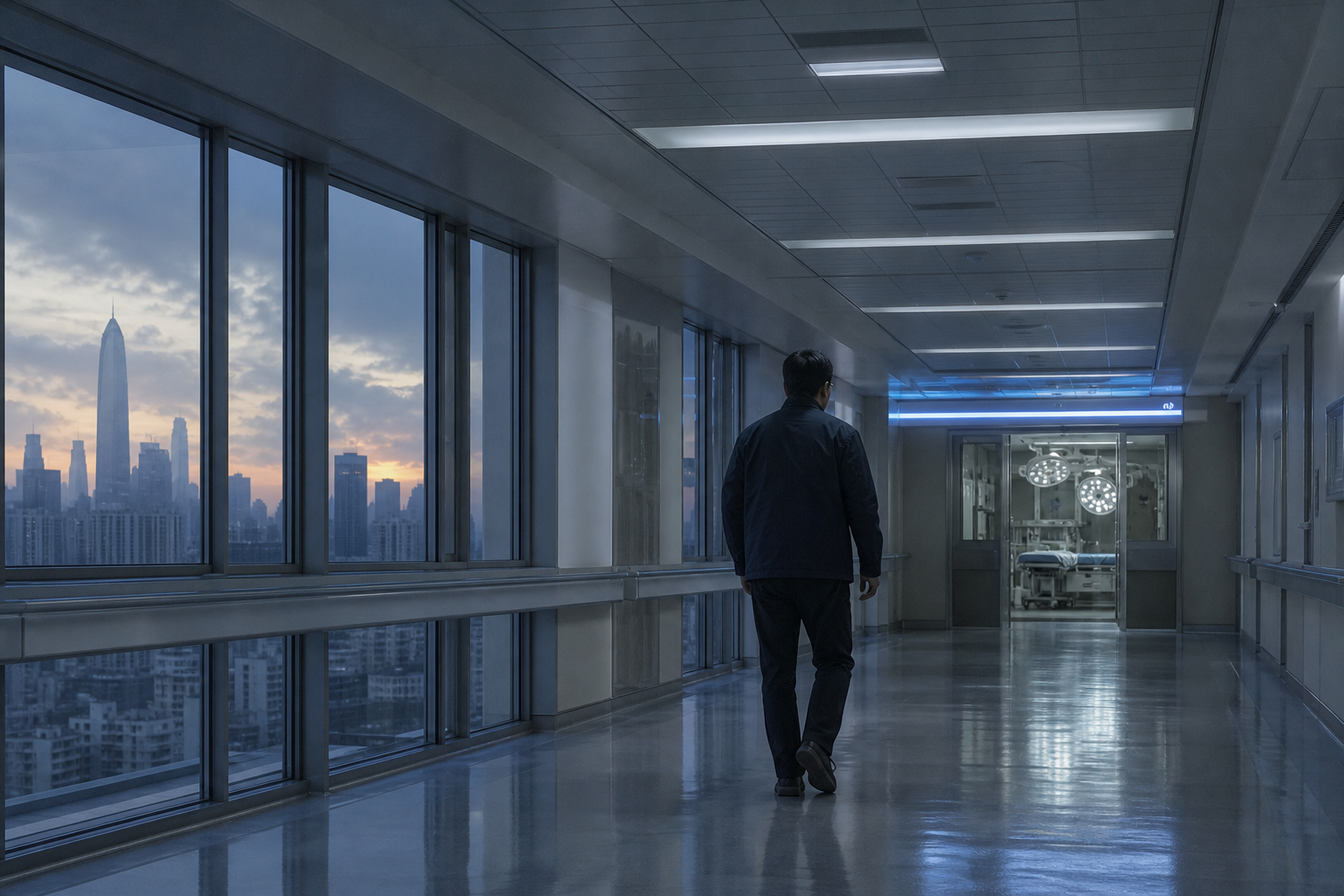
Chapter 24 · The Price of Platinum
The surgery was scheduled for eight o’clock in the morning.
Lu Yuan arrived at the hospital before six. He didn’t tell Farhan, didn’t tell Amina, didn’t tell anyone still operating the SkyWalker protocol in that Bao’an apartment unit. He walked out of the old elevator-less building alone in the gray-blue morning light, bought a cup of soy milk and a steamed bun at a shop that had just opened on the street, stood at the shop’s entrance finishing the soy milk and the last bite of the bun, wiped his fingers with a napkin, and walked toward the subway station that led to the hospital.
There weren’t many people on the subway car. Early commuters sat silently on the benches or leaned against the doors, most with their heads down, phone screens illuminating their faces — some scrolling short news, some watching videos, some handling work messages. Their phones were all connected to Starlink’s network. Every data packet was metered, billed, recorded. No one in the subway car cared about this. It was their daily routine — never chosen — living as naturally as breathing in a world where every piece of information was taxed.
Lu Yuan stood near the door, holding the overhead loop. He wasn’t looking at his phone. He watched the tunnel walls flow backward at a steady speed past the window — those gray concrete surfaces intermittently illuminated by lights, like a never-ending strip of film appearing and disappearing in the darkness.
The subway arrived at the hospital station at 7:12. He walked out and followed the familiar passage toward the exit. He had walked this passage many times in the past two months — the first time to bring his daughter for initial examination, then to hear Dr. Zhao explain the imaging results, then everyround trips before and after each remote consultation. The floor tiles were light gray, a few replaced here and there, their color slightly different from the surrounding ones. A fluorescent light every few meters on the ceiling, one of them flickering at about twice per second, like a drowsy insect breathing in irregular pulses.
He walked through the outpatient lobby. The lobby was already getting busy — patients and families waiting on plastic chairs for their numbers to be called, people queuing at self-service registration machines, an elderly couple picking up medicine at the pharmacy window. A middle-aged man in a Silver-tierbadge jacket stood in the corner of the lobby, holding his phone screen-up, trying to find a better signal position — Silver-tier users had lower priority and experienced noticeable network latency during peak hours. As Lu Yuan walked past him, the man was saying softly into the screen: “…the signal’s not great, say that again — it cut ou— ”
He didn’t stop to hear the rest.
He walked into the inpatient elevator. The doors closed. The floor indicator climbed one by one. He pressed nine — the surgical floor.
He was alone in the elevator. The metal panel reflected his face — more haggard than he’d thought, deeper eye sockets than he remembered, the line of his jaw sharper from days of nearly uninterrupted tension. But he didn’t care about his own face. He cared about the phone in his pocket — no new messages. From last night until now, his daughter’s surgery confirmation had been locked into the hospital system: 8:00 AM, operating room three, estimated duration approximately four hours. The lead surgeon was the neurosurgery director of the contracted Shenzhen hospital. The remotecontrol endpoint的时间window starts at 7:50.
Remote — those two words occupied more weight in his mind than any others. Remote meant signal. Signal meant link. Link meant 120,000 metal stars in the sky and the routing tables between them.
The elevator stopped at the ninth floor. The doors opened.
The corridor lighting was that typical hospital corridor white — not pure white, a fluorescent white with a cool tint that washed all colors out by a shade. Both sides of the corridor were lined with closed doors and plastic chairs. The air carried the smell of disinfectant and some faint,impossible to eliminate hospital odor of its own — not from a single source, but a background fragrance created by the slow mixing of alcohol, medical tape, cleaning agents, and human secretions in a long-enclosed space.
He walked to the nurse’s station, gave his name and his daughter’s medical record number. The duty nurse checked the terminal and looked up: “Mr. Lu, Zijing’s preoperative preparation is underway. You can wait in the waiting area. The anesthesiologist will come out to confirm your signature before the surgery begins.”
He nodded.
He didn’t go to the waiting area. He walked to the end of the corridor and stopped outside operating room three. The door was tightly closed, a small screen above it showing the current operating room status. It read:
「Preparing · Estimated start 08:00」
The door was thick — not an ordinary interior door, but an airtight one with sealing gaskets, used to maintain positive pressure inside the operating room. No window in the door. Standing before it, he could see nothing. Only the text on that small screen, and mounted next to the doorframe, a communication terminal connected to Starlink’s remote medical link — a fifteen-inch display mounted on the wall, currently black, in standby mode.
That was the screen he would use to see the remote expert’sfootage.
Lu Yuan stood before that door for about thirty seconds. Then he turned and walked to the waiting area.
The plastic chairs in the waiting area were that light blue, four-seat connected public seating. He picked a spot near the corner — a position that could see one end of the corridor and the side of the nurse’s station, but couldn’t directly see the operating room door. He didn’t know if he had deliberately chosen to avoid that direction, or if his body had arranged it by instinct.
He sat down on the plastic chair. It was hard. The seat cushion, after years of use, had been worn into a slight depression by countless bodies, and when he sat, his hips slid unconsciously toward the center of that depression.
He took out his phone. No new messages. He unlocked the screen, locked it again, and put it back in his pocket.
He didn’t know how long he sat there — perhaps less than ten minutes. In the waiting, his perception ofspecific duration became unstable, like a computer that had lost its reference clock, estimating the flow of time only through external events. The first event: the anesthesiologist walked out, holding a consent form, and sat down in the seat next to him. The anesthesiologist was about forty, his voice steady, his speech not fast, explaining the anesthesia plan, risks, and possible complications in the tone of someone who had become very accustomed to this kind of conversation over years of practice. Lu Yuan signed at the bottom of the consent form. His signature looked slightly different from usual — the spacing between strokes a little larger than normal, as if his hand hadn’t yet recovered from some state of frozen tension.
The second event: 7:50. A wheeled sound came from the end of the corridor. His daughter lay on a transport bed, pushed from the elevator direction by a nurse and an orderly. Lu Yuan stood up.
His daughter was wearing hospital surgical attire — for a five-year-old, the gown was too large, the sleeves rolled up twice, the hem nearly reaching her knees. She lay on the bed in that child-specific posture of relaxation — her head tilted slightly to one side, one arm extended outside the blanket, holding a small carved wooden elephant.
That elephant from Lagos, carved from ebony, its trunk raised upward.
When she saw Lu Yuan standing by the corridor, she smiled at him. It was a smile that belonged to a five-year-old who didn’t yet know what fear was — the kind of smile of someone whom life hadn’t yet taught what to worry about.
“Daddy, after the surgery, we can go home?”
“After the surgery, we go home.” Lu Yuan’s voice was steadier than he’d expected.
“Then you wait at the door for me.”
“I’ll be right at the door.”
His daughter nodded, her fingers tightening around the wooden elephant. Then the transport bed continued moving forward, through the automatic sliding track of the operating room’s airtight door. The door opened. The bed was pushed in. In the last gap before the door closed completely, Lu Yuan saw his daughter turn her head and press the trunk of the wooden elephant against her lips — just lightly, like she was kissing it.
Then the door closed.
The status screen above changed from 「Preparing」 to 「In surgery · Started 08:02」.
Lu Yuan stood still until the text on the screen had stabilized for about ten seconds, then walked back to that plastic chair in the waiting area and sat down.
He didn’t cry, didn’t tremble, didn’t make any behavior that could be identified by others as “experiencing a major emotional impact.” He just sat on that chair, back against the hard plastic backrest, hands flat on his knees, gaze fixed on a tile on the opposite wall whose color was slightly different from the ones around it. His breathing rate was slightly faster than usual, but that was all.
For the first forty minutes after the operating room door closed, he kept looking at his phone.
He was watching the monitoring terminal — not an ordinary phone interface, but the hospital’s “family remote viewing terminal” — a video stream connected to the maincamera inside the operating room via Starlink’s medical dedicated line. The footage was encrypted and transmitted to this terminal in the family waiting area, showing the interior of the operating room with about a fifteen-second delay.
The resolution wasn’t particularly high, but enough for him to see everything.
The surgical light above the operating table was on. His daughter was already anesthetized, her small body covered in dark green surgical drapes, only the surgical area on her head exposed. The lead surgeon’s hands appeared in the frame — gloved fingers, steady, precise, without any extraneous movement.
He recognized those hands. Not because he knew the surgeon personally — but because he had watched too many of this doctor’s surgical videos in the past few days. Those hands were among the most trusted in Shenzhen’s neurosurgery field.
But in today’s surgery, those hands weren’t the only onescontrol.
In the lower right corner of the frame was a small window — the remote expert’s synchronouscontrol界面. The window showed the status of two signal paths: the primary path (Starlink QKD encrypted link, for transmitting the expert’s real-timecontrol instructions) and the backup path (terrestrial fiber link, for接管 if the Starlink signal was interrupted). At this moment, both paths showed green — online, stable, latency within acceptable range.
In the upper left corner of the frame, there was also a small line of text, showing the current surgery timeline:
「Autonomous System Assisted Mode · Remotecontrol signal source: Charité — Berlin · Link latency: 187ms」
Lu Yuan stared at those words. Berlin. He remembered Mia sitting in that windowless basement apartment in Berlin, uploading a file through an old telephone line to an ancient FTP server. It was a scene he had never witnessed with his own eyes, but he could imagine.
He could also imagine another scene — somewhere along that signal path, inside a satellite numbered STK-something, in its debug buffer, a string of code that didn’t belong to Starlink’s billing system was hiding. Data Haven. That autonomous domain he had activated with his own hands beside the abandoned ground station in the early morning.
It existed quietly in the gaps of that routing table, less than three percent of Starlink’s total capacity. It was an uninhabited enclave — a digital space no one had actually used yet, one that paid no tax. It sat there in silence, doing nothing, transmitting no data. It just existed.
But its existence alone had already changed sometiny pressure distribution in Starlink’s routing layer. Like a boat docked in a channel — it didn’t need to move, just being docked changed the direction and speed of the water flowing around it.
Thosetiny changes in water flow were now propagating from one satellite to another through the routing protocol network. Some BGP update times were delayed by a few tenths of a second. Some routing table verification cycles consumed extra processing cycles. Some data packets that should have been forwarded with priority waited an extra millisecond in the gateway satellite’s queue. Not failure, not interruption — just pressure. Like adding an extremely light, almost unmeasurable extra tension to an already taut string.
He watched the surgicalfootage.
He watched those hands.
He watched the green indicators on the two signal paths — primary and backup. Both were steadily lit.
Time flowed slowly through the changes on the screen. From the timestamp on the monitoringfootage, he read: at the thirty-seventh minute of surgery, the lead surgeon magnified a certain area with the microscope and used extremely fine instruments to perform the first critical operation. On his seat, his fingers curled unconsciously — not a fist, but that posture of wanting to grasp something but grasping nothing, fingertips bending inward.
He controlled himself and put his hands back on his knees.
Then it happened.
Not in any dramatic way. Not as any anomaly appearing in thefootage, not as any sound coming from the operating room. Only on the monitoring terminal screen — in that window showing the status of the two signal paths — the primary path’s green indicator, without any warning, turned yellow.
Then it turned red.
Then —
「Connection lost · Primary path signal lost · 0 seconds」
He stared at those words.
His pupils showed no change — they simply locked precisely onto that position, like a tracker that had suddenly stopped moving upon finding its target.
The numbers on the screen began to tick:
0.24s · Backup path: not接管ed 0.51s · Backup path: not接管ed 0.73s · Backup path: not接管ed
In that moment, he wanted to stand up. His thigh muscles contracted, his core muscles prepared for themotion of standing — but themotion was never completed. Not because anything was阻止 him. Because before his body could complete that set of musclecommand, his brain had already received another set of more priority signals: standing up wouldn’t help. He couldn’t rush into the operating room. He couldn’t take that machine away from his daughter’s brain. He could stand, or he could sit — these choices, in the face of those two seconds of signal loss inside that operating room, were equivalent.
He sat back down.
0.97s · Backup path: not接管ed · Autonomous mode activated
The red text on the screen stabilized.
He looked at the terminal screen again. Thefootage inside the operating room continued — no interruption — the surgery continued. The lead surgeon’s hands didn’t stop. The curves on the anesthesia monitor still oscillated at a stable frequency. Everything was normal. Everything was as if nothing had happened.
Only in that gap of less than one second, the stream ofremote control instructions from Berlin had been cut off. In that gap of less than one second, the machine — that autonomous辅助 system connected to the remote expert’s console — had taken over. Based on the pre-loaded safety protocol, having received no newcontrol instructions, it maintained the current instrument position. It was precise. It operated according to design specifications. During that less-than-one-second autonomous mode, it made no erroneous actions.
But it was autonomous.
No one — no one in the world — could immediately determine, after that autonomous decision of less than one second, whether it had produced any invisible effects. Thedrift could be at the sub-millimeter level. Could be at the boundary of nerve bundles. Might not exist. Or might. No one knew.
Because that disconnection of less than one second had left no trace that could be immediately assessed.
It had only left one question.
Lu Yuan sat on the light blue plastic chair. He moved his gaze away from the screen — not because he dared not look, but because he knew continuing to watch thefootage wouldn’t show him the answer he needed to see. What he needed to see was whether that autonomous operation of less than one second had caused anydrift — and that was something that needed time to confirm. Not now. Not in this waiting area. After his daughter woke up. After the first post-operative检查. In the next few hours and days.
He moved his gaze from the screen to the end of the corridor. That airtight door was still shut. The screen above it showed:
「In surgery · In progress 01:31」
He didn’t know how he got through the next period of time.
Not that he lost his memory — but the time序列 he remembered was no longer measured in minutes and seconds, but in the frequency of the operating room door opening and closing, the frequency of nurses entering and leaving the corridor, the type of sounds made by machines at the end of the corridor. Every time the door opened, his gaze tracked its trajectory. Every time it closed, his gaze returned to some unspecified point ahead — the fire extinguisher instructions on the wall, the number of fluorescent tubes on the ceiling, the direction of the lines extending along the floor tiles.
He didn’t check the time on his phone. He dared not. Not because he feared time was passing too slowly — because he feared time was passing faster than he thought, and he wasn’t ready for the outcome.
The sentence Milan had said in that phone call kept replaying in his mind like a looping audio file: “Humanity is only one second away from the dark age — if in that one second, Starlink can’t receive your signal.”
He thought he had understood the weight of that sentence then. But he hadn’t. Back then he thought it was a concept. A metaphor for understanding the fragility of the world. Something that could be discussed, analyzed, and liked in a speech.
He now knew it wasn’t a concept.
It was a fact. And that fact had a precise length: 0.97 seconds. The red alert on his phone — he had read it many times. Connection lost. Autonomous mode engaged. 0.97 seconds. He began to wonder, in those 0.97 seconds, whether the decision made by the machine’s autonomous system was truly indistinguishable from what a human expert would have done. He began to wonder, when Milan designed the Starlink system, whether he had ever considered this question — when his network dropped out for one second, how many machines in the world would enter autonomous mode, how many families would begin waiting on plastic chairs, how many people would find themselves in front of a darkened screen, sitting, unable to do anything but sit.
He couldn’t hate Milan. He couldn’t hate Farhan. He couldn’t hate Silas. He couldn’t hate the Data Haven code still expanding. Because the root of those 0.97 seconds could be traced back to everyone’s choices — including his own.
He had launched SkyWalker.
He had typed that reply: “The seat is yours. Come on in.”
He had stood in the wild grass of that abandoned ground station, watching Farhan press the transmitter’s power switch, and hadn’t stopped him.
He thought the price of freedom could be calculated — measured between a daughter’s medical record and a surgery. But now he found that the price wasn’t a static number. It was a variable. And you never knew its final value until the bill appeared in front of you.
He was looking at that bill now.
He was still sitting on the plastic chair. He turned his phone screen-down on the empty seat beside him, no longer looking at that red alert record. He left it there, its plastic casing against the light blue seat surface, like an instrument that had completed its mission and was waiting for its results to be read.
Someone was walking in the corridor. A nurse pushed a machine past, the wheels making a rhythmic sound on the floor. From somewhere in the distance, a call bell rang from a ward, short and repetitive, like a bird that refused to stop.
He didn’t hear any of this.
What he heard was his own breathing — not because he was刻意 listening, but because it floated up on its own in the surrounding quiet. The gap between each inhale and exhale, about three to four seconds. Steady. Continuous.
The surgery was still in progress.
He could only wait.
Three hours and forty-seven minutes.
In Lu Yuan’s perception, the length of this period wasn’t defined by the movement of the clock’s hands. It was defined by the periodic patterns of activity he observed in the corridor: one nurse shift change, the cleaner passing twice, seven openings of the operating room door — five times for nurses entering and exiting to fetch instruments, once for the anesthesiologist to come out, take a phone call, and go back in, once for an unfamiliar operating room staff member pushing a blood analyzer in.
Each of those seven door openings, his gaze followed the trajectory of the door. Each time, behind that door, he saw more green drapes and the glint of metal instruments and dark blood — not a lot, a small patch on a gauze being quickly removed.
He stopped watching the监控 screen. He just watched that door.
Then it opened — not that brief, single-person-sideways pass opening — the kind of steady, full opening that marked the end of surgery. The lead surgeon stood in the doorway. The edge of his surgical cap pressed against his forehead. His mask had been removed, revealing his entire face.
It was a face that had learned, over years of surgical practice, how to convey news of any magnitude to families. But no matter how trained, when a person walks out of an operating room to face someone waiting in the corridor, that person’s face will always reveal something they themselves are unaware of. Not the voice, not the words — the eyes.
The lead surgeon’s eyes held no fear. No heaviness. No “I don’t know how to tell you this” stillness. But also no complete, thorough, clean relief.
When Lu Yuan saw those eyes, he stood up. He didn’t ask any questions. He stood in front of that just-opened airtight door, letting the doctor speak first.
“The surgery is complete.” The doctor’s voice was steady, nearly identical to his pre-operative consultation tone. “The lesion was removed very smoothly. From a technical perspective — the operation path was clean, no明显的 intraoperative complications, vital signs stable throughout.”
There was a gap in this speech. A verytiny — sotiny that if Lu Yuan weren’t someone waiting for some uncertainty, he wouldn’t have noticed it — gap. That pause of a fraction of a second after “from a technical perspective.”
“But.” Lu Yuan said. Not a question.
The doctor looked at him. The mask was already off, the red pressure marks on his face clearly visible under the light.
“During the second phase of the surgery — approximately one hour and thirty-one minutes after start — there was a brief disconnection in theremote control signal. Approximately less than one second. The辅助 system automatically switched to autonomous mode. The switch was very smooth, causing no instrument displacement orjitter. We did an immediate assessment under the intraoperative microscope — no visibleoffset差 was found.”
He paused. The corridor was quiet. From somewhere in the distance, a machine emitted a steady low-frequency hum.
“But in neurosurgery, there are some fine degrees ofdrift that are not visible to the naked eye during surgery. Those subclinical-level changes — the kind on the edge of resolution of modern medical imaging technology — require the post-operative recovery period to confirm.”
Lu Yuan knew what the doctor was saying.
“So the surgery was successful. But — that autonomous operation of less than one second — we cannot currently assess whether it caused anytinyoffset差. Observation is needed. Approximately forty-eight hours.”
When the doctor used the words “forty-eight hours,” Lu Yuan didn’t interrupt him. He stood in those words for about three seconds, letting his breath complete one full cycle in his chest — fill, hold for half a second, then release slowly.
“Can I see her?” he asked.
“Post-anesthesia recovery room. She’ll wake from anesthesia in about twenty-five minutes. You can sit beside her.”
The doctor didn’t stay long. There was still follow-up work to handle in the operating room. Before turning, he looked at Lu Yuan — in that look, as a neurosurgeon, he had given everything he could. The rest wasn’t something a doctor could give.
Lu Yuan didn’t return to the waiting area. He stood in the corridor outside the operating room, leaning against the wall, waiting.
He looked at the hospital clock on the corridor wall — the hands showed 11:51. He finally checked the time. Not to know how much had passed — to know how much longer he had to wait until he could see his daughter open her eyes.
Twenty-five minutes later, he walked into the post-anesthesia recovery room.
His daughter lay on a semi-reclined bed. Her head was wrapped in white bandages, a tiny, almost invisible pale yellow patch at the edge near her temple — the color of disinfectant mixed with blood. An IV line was connected to the back of her hand. The monitor at the head of the bed showed her heart rate, beating steadily.
She wasn’t fully awake yet — the effects of anesthesia were slowly receding. Her eyes were closed, her breathing slightly faster than normal sleep, her lips slightly parted, as if she had quietly said something in her dreams.
Lu Yuan sat down on a round stool by the bed. The stool’s surface was metal, cold.
He placed one of his hands — fingers spread — on the edge of the sheet, close to where his daughter’s hand lay. He didn’t hold it — a pulse oximeter was attached to her finger, and he didn’t want to disturb the line. He just put his hand there, letting his body heat pass through the sheet into the air beside her.
About ten minutes later, her eyelids moved.
Then her eyelashes — afaint flutter.
Then her eyes slowly, as if浮起 from deep underwater, opened a crack.
She looked at the ceiling, blinked twice more. Then her pupils found their direction — she looked at Lu Yuan by the bedside.
“Daddy.”
Her voice was very small, very small — the kind of voice like fluff that a five-year-old exhausted by anesthesia and surgery could produce. But in the quiet of the recovery room, against the backdrop of the monitor’s regular beeping, it was as clear as a coin landing on a glass surface.
Lu Yuan didn’t answer. He couldn’t. He just moved his hand forward a little — one finger touched the inside of her wrist. There, he could feel her pulse, through her thin skin, beating steadily, like a signal that had just been confirmed still operational.
Her eyelids blinked again. Then, in that post-anesthesia voice, half the speed of normal speech, she said: “Just now — for one second — you weren’t there.”
Lu Yuan’s finger stopped on her wrist.
“Not really not there.” She was努力 organizing her still-recovering-from-anesthesia language. “It’s like — I couldn’t see you. For just a little bit. Then I saw you again.”
She didn’t say “signal,” didn’t say “disconnection,” didn’t say anything technical. She said “you weren’t there.” In a five-year-old’s perception, that 0.97-second interruption wasn’t a network fluctuation — it was her father disappearing from her field of vision for less than one breath, then coming back.
Lu Yuan didn’t speak. He used his other hand to gently cover his own eyes, staying there for two or three seconds. Then he lowered his hand and looked at his daughter’s face again.
“I’m here,” he said. “I’ve been here the whole time.”
He sat there. The pulse inside his daughter’s wrist beat softly, continuously beneath his fingertips. He didn’t need to speak. He didn’t need to do anything. His entire existence had condensed into that point of contact between one finger and one pulse.
He remembered many things. He remembered in the Data Party safe house, when Farhan showed him the first successfully decoded SkyWalker data packet and said — “It’s small. But it’s free.” He was now sitting in a post-anesthesia recovery room, his daughter just woken from surgery, her pulse beating under his fingers. His freedom now had a specific unit of measurement.
Its unit was 0.97 seconds.
Its price was a 48-hour observation period.
He didn’t know whether, at the end of these 48 hours, what he would receive was a “everything is normal” confirmation, or an uncertainty he would have to carry for the rest of his life. He didn’t know whether those 0.97 seconds had changed something in his daughter’s life — sometinyoffset at the boundary of nerve bundles that he could never undo. He didn’t know whether the fear he felt at this moment was the price of freedom, or the punishment for freedom.
But his daughter was awake.
She was looking at him.
Her eyes focused in his direction, like someone who had traveled back from very far away and finally seen familiar lights.
She didn’t yet know about those 0.97 seconds. She didn’t yet know that her life might have been changed slightly by some code inside a satellite flying overhead that didn’t belong to any billing system — whether that change was good or bad, no one knew. She had just had surgery, anesthesia was wearing off, painkillers were taking over, and her father was sitting beside her, his finger touching her wrist.
At that point of contact, in a space so small it needed no Starlink connection, no data plan, no token billing — between a father and a daughter, separated by one finger and the distance of one pulse.
It wasn’t in any routing table.
It needed no one’s permission.
It existed at the tip of that finger, where beneath the skin, an artery was pulsing at approximately one hundred times per minute. That pulse wasn’t maintained by any satellite, wasn’t forwarded by any protocol, wasn’t authorized by any billing system.
It was just there.
No signal needed.
No connection needed.
No star in the sky needed to confirm whether it was real.
Lu Yuan lowered his head, gently, extremely gently, rested his forehead on the edge of the sheet. He didn’t cry out loud — he wasn’t sure if he was crying — but he pressed his forehead against that white fabric, letting its texture press into his skin, as a confirmation that he was here, right now.
Somewhere far away — inside one of those metal stars flying quickly overhead, in some shadow cache, a string of data belonging to no routing table, belonging to no billing system, was still quietly existing. Small. Less than three percent of Starlink’s total capacity. No tax. No payment. Not part of any system record.
It wouldn’t disappear on its own. It wouldn’t grow quickly either.
But it would continue to exist there — for a very, very long time to come — like a house that had embedded its own genes into the walls, so that every time the walls were knocked, it made a sound that didn’t belong to the raw material of the wall itself.
Lu Yuan didn’t know what that echo would eventually become. Maybe Milan was right. Maybe a 2.37% crack wouldn’t expand, but would be just enough for some people — not many, but some — to breathe a little air that didn’t need to be taxed from that gap.
Maybe that little bit of air would be enough.
Maybe that little bit of air — at a particular moment, beside a particular person — could exactly fill a gap in the breathing of a father sitting in a post-anesthesia recovery room.
His daughter’s wrist was still beating steadily beneath his fingers.
He continued sitting in that position, not leaving, not lifting his head, not checking the time.
He was waiting for those forty-eight hours to pass, for the doctor to give the final confirmation. He was also waiting for another thing — waiting to be able to understand what it was that he was feeling right now: whether it was the relief of freedom finally arriving, or the exhaustion of a person who hadn’t expected freedom to be this heavy.
He didn’t have an answer yet.
But he was still sitting there. His daughter’s wrist was still beating.
Outside that airtight door, the city’s Starlink signals were still transmitting. Financial data, video calls, social media, remotecontrolcommand — you could connect to anything anywhere, as long as you could pay the price.
But in this recovery room, by the side of this bed — at a spot where a father touched his daughter’s wrist with one finger — nothing needed to be connected. No network. No signal. No Starlink.
The pulse itself was a connection.
The most primitive, untaxable connection — it had been flowing in human blood vessels for millions of years, long, long before all the satellites and protocols and firewalls and routing tables existed.
Lu Yuan closed his eyes.
Beneath his palm, the pulse beat steadily, like a lighthouse needing no power, on a coast with nothing, continuously emitting its own light.